The Best and Worst of Star Trek: Lower Decks Season 4
Lower Decks delivers a brilliant fourth season, improving on the third, but is held back by one stinker of an episode
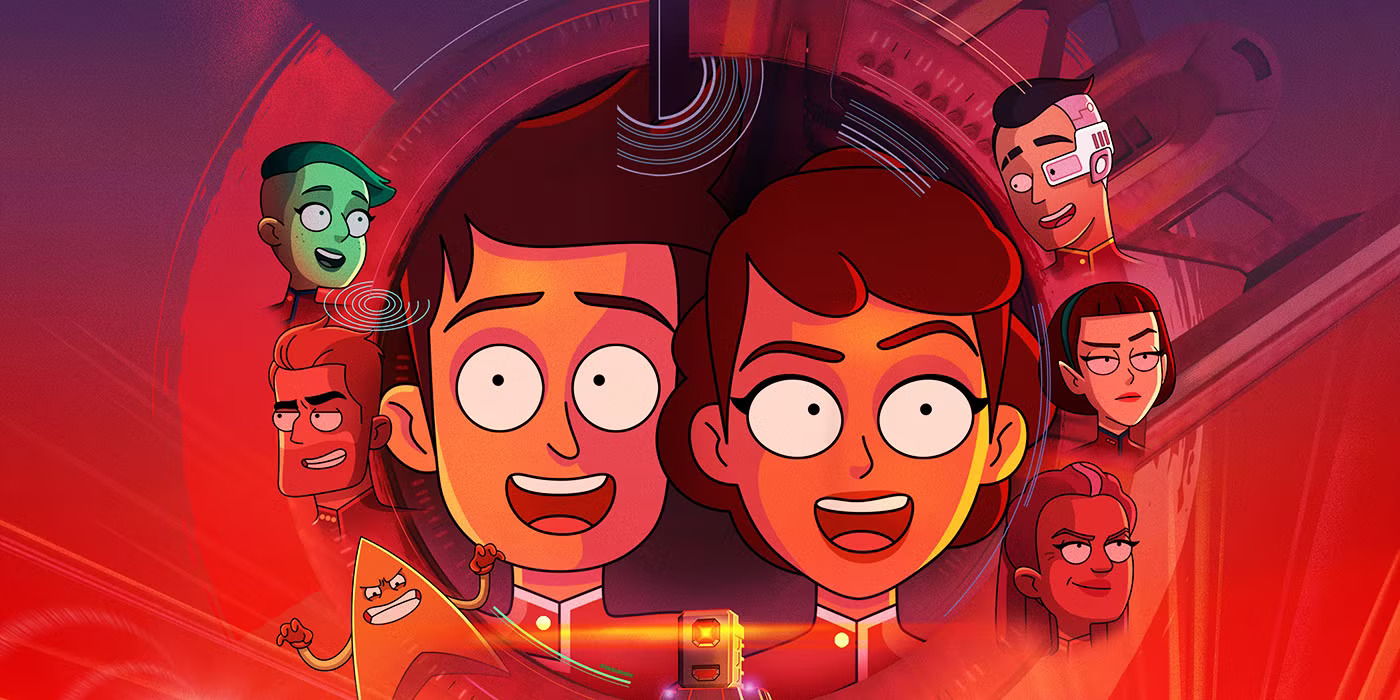
The fourth season of Star Trek: Lower Decks is a clear marker of the show’s evolution. The animated comedy series has matured, grown, just like its characters. It’s still capable of zany, meta adventures but by this point it’s a seasoned Star Trek series, with strong story and character arcs. After maybe a slightly lacklustre third season, unable to follow up its excellent second, the show is truly back on track with its fourth. The main cast have been promoted, now lieutenants junior grade, causing a shake-up at just the right time. They have new responsibilities and authority, leading away missions and having access to new parts of the ship, deepening the crew and offering new opportunities for comedy without totally eliminating the fresh, lowly perspective on Starfleet the show offers.
Season 2’s Wej Duj is undoubtably the show’s masterpiece and the fourth season makes it clear that showrunner Mike McMahan knows that. The season tries to essentially be a season long version of that episode, taking inspiration in several regards. Almost every episode features a scene showing the lower decks crew of a different alien vessel, from Bynar to Ferengi, and they all connect into one season long arc. Unlike the third season, the serialised plot is dominant from the start, which each standalone episode adding something that’ll pay off in the two-part finale. Not to mention that characters from Wej Duj reappear here, including the young Klingon. Although, at the risk of sounding racist, all Klingons in this show look alike and I didn’t know it was him at first. And that episode’s breakout star T’Lyn joins the Cerritos crew as a recurring character, and she’s a perfect addition.
While there are a few B-plots which feel too goofy for an in-continuity show (looking at you Mark Twain negotiations and slam poetry) and one stinker of an episode (more on that later) this season is content to let more serious moments breathe. I don’t think season 4 tops the vibrant energy and variety of the unbeatable second season but it comes close, growing ever more comfortable. The show by now has stopped just referencing old stories and has truly began charting a new course forward, expanding the canon, making the universe feel larger rather than smaller. We get an episode exploring Ferenginar beginning the process of joining the Federation, which is huge. Something Borrowed, Something Green finally shows us the Orion homeworld and dives deep into the culture. They may be a key race who have existed since the sixties but its Lower Decks which gives the Orion species the most informative and focused episode in the entire franchise.
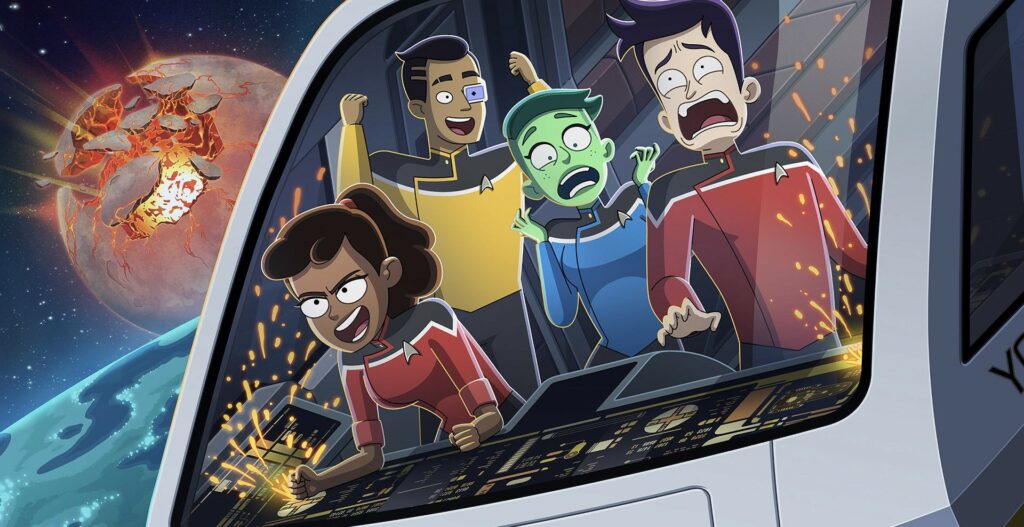
Best Character: D’Vana Tendi
After Boimler got the focus in season 2, and Rutherford in season 3, the fourth season very much focuses on the show’s female characters. The two final episodes get to the heart of Mariner and her struggles with a depth I wasn’t expecting. We learn why she doesn’t want to progress above an ensign, that she doesn’t want to be put in the position of ordering her friends to their death after what happened to her friend Sito, and so recklessly handles all the danger herself. Making her a veteran of the Dominion War is fascinating and this comedy show is the first to actually explore the lasting consequences of that conflict on Starfleet and their values. It should be about exploration but all a generation have known is death.
T’Lyn is also a highlight of the season. The main four cast members are well drawn but often match each other’s shouty vibes too easily. T’Lyn is the perfect counterpoint to the others, both in personality and the humour she offers. Finally the show has a deadpan straight man, whose ability to keep calm under pressure and the rambunctious escapades of the crew leads to some great comedy. I didn’t realise what the show was missing until she showed up. And she’s a genuinely great Vulcan character, one of the best in the franchise, with the comedy naturally fitting her race. It was a risky move turning a guest character into a recurring crew member, that the joke would get stale or the character would be forced to change too much, but she works wonderfully.
Yet as strong as Mariner and T’Lyn are, I think the best character of the season is Tendi. Finally the show gives her her due. It’s been a long time coming, with further characterisation and revelation about her past teased in seasons past, but this is where she comes into her own. While I wish we got more Tendi to chew on earlier, the build up being so long does make the pay off more satisfying. Her promotion on the Cerritos is great to see, with her reckoning with having more authority, becoming comfortable with giving orders. But it’s her time on Orion which is the strongest material. She can’t run or hide from her past any longer, she has to confront what she’s ashamed of, accept it and grow. Something Borrowed, Something Green is a wonderful episode and sets up the surprising final beat of the season: Tendi sacrificing her Starfleet career to save her friends and return to her life of crime on Orion. It’s a credit to her characterisation this season that the final moment works as well as it does.
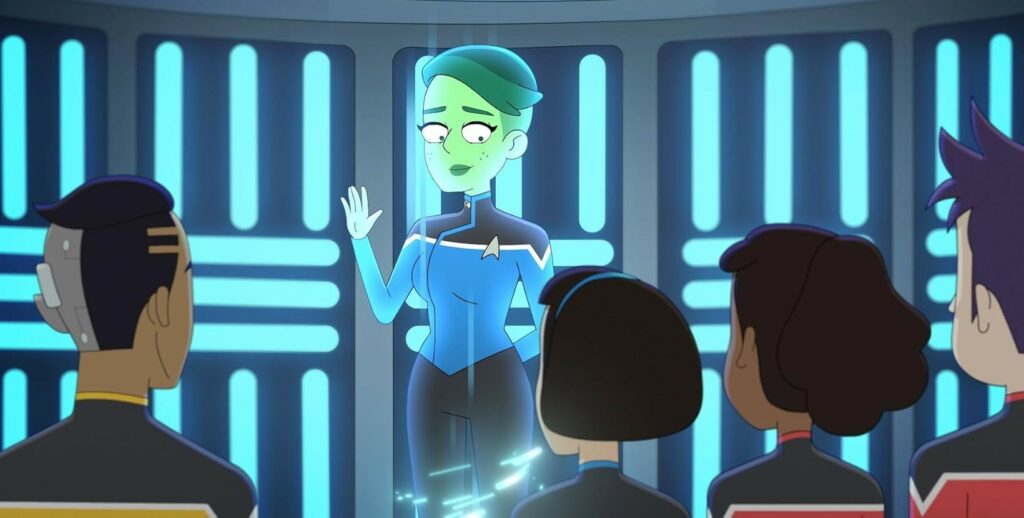
Best Reference: Janeway, the murderer in Twovix (S4E1)
The fourth season of Lower Decks gets its big, reference-filled episode out of the way early. The season premiere, Twovix, is the show’s ode to Voyager, in much the same way as last season’s Hear All, Trust Nothing was to Deep Space Nine. Wisely there are no distracting guest stars, allowing the premiere to begin this season’s main cast character arcs without disruption, but there are an insane number of Voyager references and easter eggs throughout the episode, which sees the Cerritos crew transfer Voyager to a museum. There’s also a brief mention of the Strange New Worlds crossover: “That Pike thing we aren’t supposed to talk about.”
But whereas I ate up all last season’s DS9 references, my favourite Star Trek show, I really don’t care for Voyager. I’ve watched it all, most episodes a couple of times, but it does nothing for me bar a few select episodes. Mariner may have been excited about going aboard the ship but I wasn’t. Yet there’s one reference in the episode which does work for me, and I feel it’s the kind that works for both fans of Voyager and those more critical of it. The Cerritos crew is aghast when they learn how Janeway dealt with Tuvix, essentially murdering the poor crewman when he refuses to sacrifice himself. It’s a controversial episode and one which highlights how inconsistent and occasionally brutal Janeway was as a captain. Seeing characters within the franchise learn about this is a great moment and it’s hilarious that even Shaxs is shocked by the revelation.
Although the Malcom Reed jigsaw puzzle from later in the season almost beats it. I want that jigsaw.
Best Joke: Boimler choosing his quarters in I Have No Bones Yet I Must Flee (S4E2)
After the Star Trek-specific jokes began to run dry, season 3 started to fall back on some old sitcom tropey storylines and it didn’t really work. ‘Bold Boimler’ is probably still the nadir of the show. The fourth season still relies on some cliché comedy stories but it does a much better job of at least wrapping them in a Star Trek veneer to make them more successful. I think one of them works wonderfully. Promotion achieved, Boimler gets to move out of the bunk corridor and into his own quarters, and the season’s second episode features a running joke of him finding issues with his choices. His first pick is opposite the nacelle bussard light, shining brightly through his window like the chicken roaster sign in Kramer’s place in that memorable Seinfeld episode. Then he moves to a room between holodecks, which have thin walls, meaning he can hear the sexy Robin Hood roleplay with clarity. It’s not a new joke but it is successfully transferred into Star Trek, using franchise specific elements, adapted for the franchise, which is an improvement over the previous season’s purely generic faire.
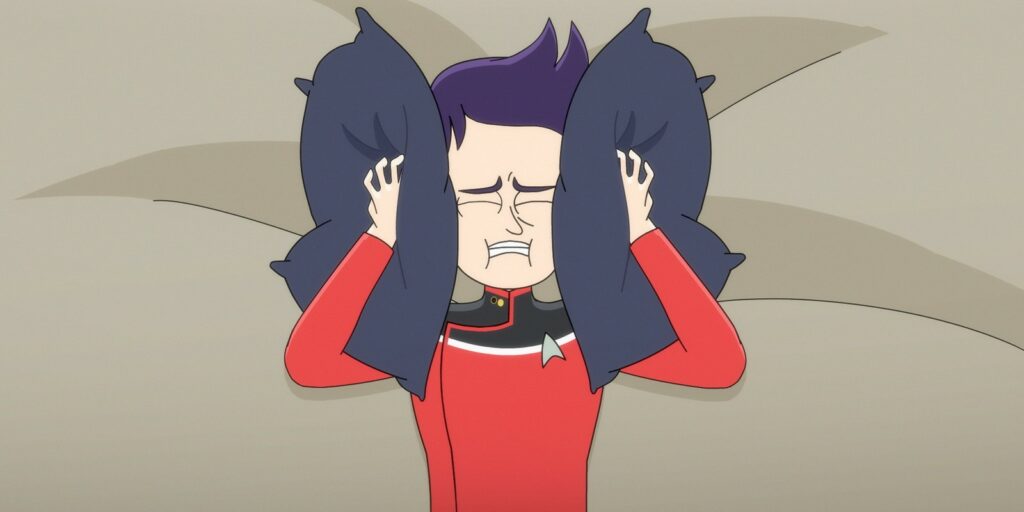
Biggest Mixed Bag: In the Cradle of Vexilon (S4E3)
I think Lower Decks has exhausted planet-controlling sentient computers at this point. I know the show is playing with a trope of the franchise but four seasons in we’ve seen enough of them. There’s nothing left to be drained from that material and yet In the Cradle of Vexilon tries. It’s an episode where the old and new, good and bad come in equal measure and I never found myself sure of how I felt about it. We get the same old computer jokes and yet the computer in question controls a planet’s weather and when it malfunctions we get some of the best visuals of the season. Or rather, it’s not a planet, it’s a Halo-like ring structure, which feels new for the franchise yet also feels more generic sci-fi than Star Trek. Even the visual language of the episode tries some new things, with a few whip pans and even a cut-away gag. As with all aspects of the episode, some of it works and some of it doesn’t.
One storytelling element I dislike is that once again the plot relies too much on miscommunication and characters not being honest with each other when there’s little reason for them not to be. At least, it appears so until the final moments when the senior officers are revealed to be treating the main cast poorly intentionally as a hazing ritual. I’m not sure what I dislike more: Lower Decks falling back on its now archetypical cliché or its characters not acting in a way befitting Starfleet. But then we get one of my favourite moments of the series: Boimler’s vision of death being a Twin Peaks reference. There’s the black-and-white chevron floor and the armchair mixed with Lower Decks visuals like the black mountain and koala. It’s a real weird mixed bag of an episode.
Horniest Episode: Empathological Fallacies (S4E5)
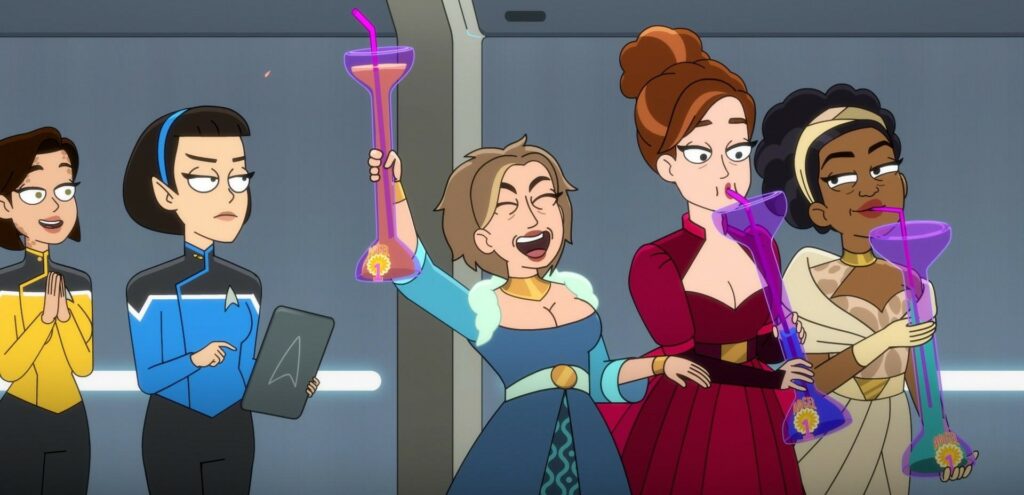
Since the beginning, Lower Decks has pushed the boundaries of Star Trek. While a considerable fan of the show, some of its sensibilities still don’t totally work for me when I try to reconcile the show’s events taking place in continuity with the rest of the franchise. I don’t want the violence to be too bloody, and the bleeped strong language is hit or miss (although that’s more execution than concept, Arrested Development remains the king of this gag). But one more ‘adult’ element that does work for me is the sex. It fits Star Trek. Gene Roddenberry’s future is one of sexual liberation and the older shows were held back in presenting and exploring this idea. Lower Decks can go further in this regard and does. The Cerritos is a horny ship. It is across the series and when three busty Betazoids are aboard, being ferried from Angel I to Risa, and T’Lyn’s Bendii syndrome causes heightened emotions, it leads to some particularly free spirted misadventures. Being more explicit about sex and the lax reactions to it leads to some great comedy throughout the series and is very fitting for this franchise, which has only previously flirted with its liberated future and can now penetrate deeper.
Best Episode Title: Parth Ferengi’s Heart Place (S4E6)
I never thought I’d see the day where behemoth franchise Star Trek would reference one of my favourite cult comedy shows. Garth Marenghi’s Darkplace is a brilliant lesser-known British comedy which ran for six episodes in 2004 and has never exited obscurity since so the idea that Mike McMahan is a fan and contrived massively to title an episode Parth Ferengi’s Heart Place in reference is an unexpected joy to behold. There’s no connection to the show in the episode proper but I’ll take what I can get, and it’s a good episode overall. Rom and Leeta from Deep Space Nine cameo, Mariner has to confront her attitude problem, Rutherford and Tendi’s potential romance is finally acknowledged for the first time, and Boimler wanting to complete an Starfleet travel guide is very Hitchhiker’s Guide to the Galaxy. The meta joke about commercials in TV shows while the Paramount logo flashes in the background is fun. But come on, Mike, you couldn’t go full Darkplace and have the big rapey eyeball monster be a background alien or something?
Worst Episode: A Few Badgeys More (S4E7)
A Few Badgeys More is a notable weak point of the season, though thankfully the only weak point: it’s the single bad episode of the fourth season. It feels like its own finale. A culmination of all the AI storylines from seasons past jammed into one episode. Badgey, AGIMUS, and Peanut Hamper all return and it all feels too much for 25-minutes. As much as I don’t want it because I only like one of those three characters, the story would have been much better served as a two-parter. There’s too much going on and the breakneck pace means key scenes, like Peanut Hamper’s hearing, happen offscreen. Peanut Hamper has the complete opposite arc to her last episode, now having a genuine redemption, but I don’t believe it because we barely see it. Until the credits began to roll I was convinced it was another trick.
AGIMUS is a great character, with a very funny performance by Jeffrey Combs, but the episode takes his villainy too far. Boimler sits back and lets him subjugate an entire planet for one quick scene. I thought the entire storyline must be a trick, that it’d be revealed to take place on the holodeck, but no, it’s real. Our lead characters just let AGIMUS take over a world because they know the Federation will come back and free it. That makes a mockery of the stakes and actions of Starfleet. And then we have Badgey. I thought three AI characters were too many but then Badgey splits himself into three, making five total. There’s too much going on and Badgey’s plan has impossibly large stakes. He infects every ship in the quadrant, can wipe out the galaxy, and then transcends into a godlike being. Sometimes Lower Decks’ silliness can slip into stupidity.
Best Episode: Caves (S4E8)
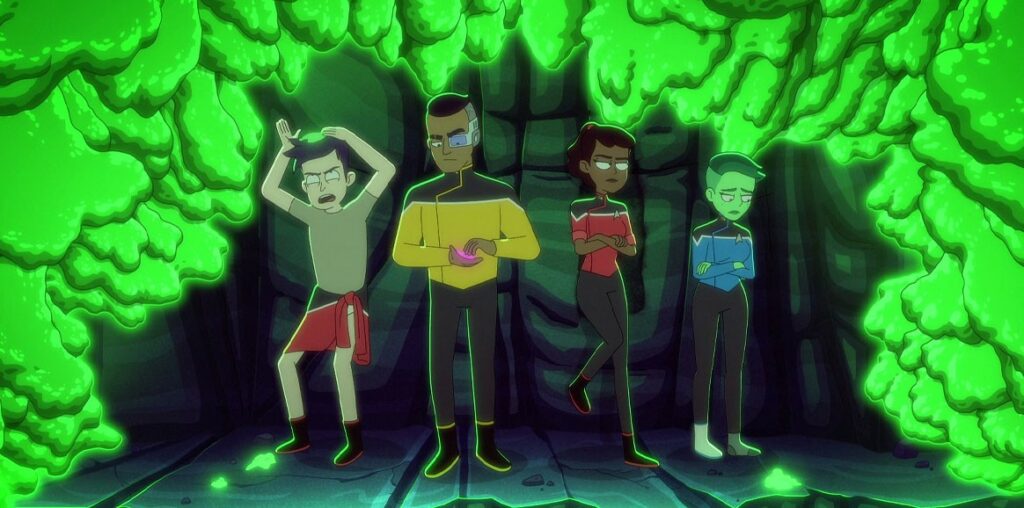
Just when you thought Lower Decks had run out of Star Trek tropes to lambast, along comes Caves. As with the best references in the show, it’s a knowing, loving episode poking fun at the repeated use of the same cave set from TNG through to Enterprise, known as ‘Planet Hell’. Every cave on every planet looks the same, with the same outcroppings and the same unrealistically smooth floor. The episode is a bottle show, taking place almost entirely within the cave, with each of the four main cast reminiscing about other adventures they’ve got up to in identical caves. I found it to be the funniest episode of the season but also the cleverest, too. While at first the memories seem to make the episode nothing but a series of sketches, they come together and inform the main action in interesting ways, unlocking the wider narrative and characterisation.
This is the perfect time for the main four characters to get trapped together. No senior officers, no guest stars, no T’Lyn. The show has been changing this season. The promotions mean everyone spends less time together, off on different missions, not sharing a bunk, and the show acknowledges this in the episode. Caves is an excuse to bring them all together and contrast the new show with the old. The four reconcile, rediscover their love for one another, yet also acknowledge their growth and change. A flashback to their first bonding experience, set seconds after the pilot episode, could have been cheesy and overly sentimental, but is effective as a point of contrast. Caves is laser focused on these characters, and is a testament to their growth, and the show’s, across these four seasons.
Best Guest Star: Robert Duncan McNeill as Nick Locarno in Old Friends, New Planets (S4E10)
I don’t like Tom Paris. He’s probably my least favourite regular cast member on any Star Trek show. He’s supposed to be a charming rogue, a charismatic bad boy, but I’ve always found him far too sleazy to be a successful Han Solo type. He was miscast, with Robert Duncan McNeill proving to be a great director but I’ve never rated him as an actor. Lower Decks however gives him the perfect role, or rather returns him to the perfect role. Before he was Tom Paris on Voyager, McNeill was Nick Locarno on an episode of TNG, who does initially fit the Tom Paris mould. Yet there’s no attempt at charm. Locarno is a villain, the big bad of the season, and I think it works perfectly; McNeill fits the role much better. He’s meant to be unlikable and arrogant: a Starfleet failure who is forming his own group of rogue lower deckers who don’t want to conform to the rules of their navies. More than a mere reference, he personifies Mariner’s internal struggle as she ultimately defeats him and decides to finally fully commit to Starfleet.
Season 4 Episode Ranking:
10. A Few Badgeys More (S4E7)
A big gap
9. Twovix (S4E1)
8. In the Cradle of Vexilon (S4E3)
7. Parth Ferengi’s Heart Place (S4E6)
6. I Have No Bones Yet I Must Flee (S4E2)
5. The Inner Fight (S4E9)
4. Something Borrowed, Something Green (S4E4)
3. Old Friends, New Planets (S4E10)
2. Empathological Fallacies (S4E5)
1. Caves (S4E8)
I’ve blazed through this show so far and can’t quite believe there’s only one season left. From conflicted beginnings to now loving it, Lower Decks deserved a long run rather than being cut short with just five seasons. If any Star Trek series deserved seven season it’s Lower Decks, even if just as a reference to the nineties shows it’s such an ode to. But it’s not over yet, the final season remains and I’ve never watched it before. Will the series manage to pull off a satisfying ending despite the cancellation?