Outland: What If Alien Was A Western?
Peter Hyams transposes western tropes into outer space with his underrated film that builds on the aesthetic and ideas of Alien

I took a chance on Outland. Arrow Films have just released a new 4K restoration and I picked up a copy, thinking it looked like my kind of film. I hadn’t a clue just how much it resembled my kind of film, namely my favourite film: Alien. Releasing in 1981, Outland, written and directed by Peter Hyams, at first appears to be Alien without the Alien. And while it comes to set itself apart from Ridley Scott’s masterpiece (instead coming to resemble a different film entirely), the comparison is apt and made admiringly. I’ve completely fallen in love with Outland.
From the opening frame the film draws influence from Alien. The shot of space; the eerie soundscape somewhere between music and sound effects, with both films featuring a score by Jerry Goldsmith; the title revealing itself among the stars. Hyams wears his influences on the sleeve of his spacesuit, which of course also look like those in Alien. Rather than a ship, Outland is set on Jupiter’s moon Io, and how do we know this? Because we get some green computer text on the screen, giving us the crew complement and other information on the base. Just like the start of Alien.
The base of Con-Am 27 is straight from the world, or galaxy, of Alien. It continues that film’s grounded, dirty view of the future. These aren’t astronauts in perfect white Apple Store spaceships, they’re miners and truck drivers in space. Blue collar sci-fi. While Alien showed life for a small crew on a single ship, Outland expands to a base of thousands living together in cramped conditions. It almost makes the claustrophobic corridors of the Nostromo feel large by comparison. Con-Am 27 is part oil rig, part western frontier town, and almost part prison. You can just imagine Ripley and co stopping off here before venturing into deep space. The production, visual, and aural design, the tone and atmosphere, make Outland feel like a genuine part of the Alien canon; a consistent vision of the future in space, to match Blade Runner’s vision of Earth.
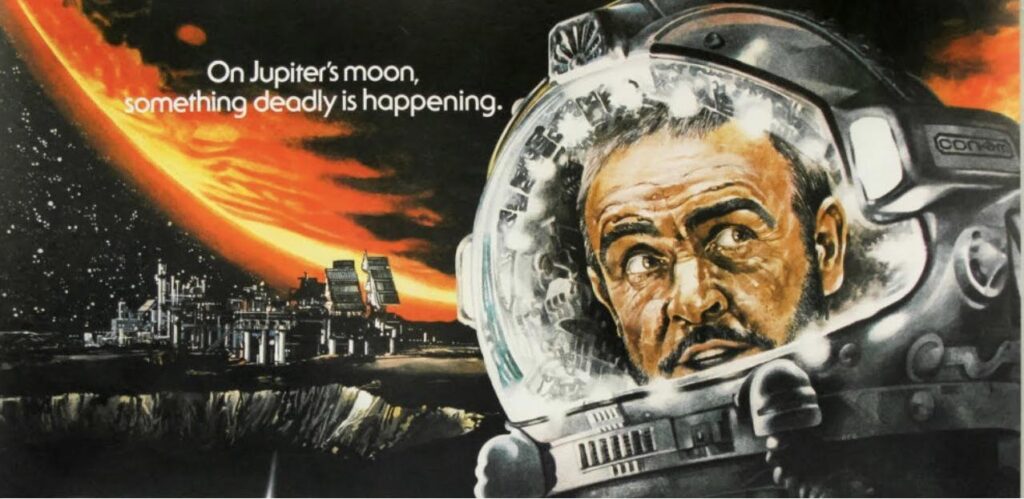
The base is full of regular people, manual labourers, discussing contracts and bonuses, all of them wearing caps and vests and overalls with patches, puffing away on cigarettes. The organisation in charge may not be Weyland-Yutani but it is colloquially referred to as ‘the Company.’ And characters interact with a central computer, where you have to manually type in questions and have a conversation, just like MU-TH-ER. It’s all very Alien, until it begins to set itself apart.
One of the miners, played by John Ratzenberger (disturbingly without a mustache), begins to freak out, acting like there’s an alien spider. The twist is that in this film there isn’t one. He’s just going insane, and before you know it has pulled loose his pressure suit and burst into a bloody pulp. In Outland it’s still true that in space no one can hear you scream, but it’s not aliens making you do so, it’s man. While corporate greed was a background idea in Alien, here it’s brought to the fore. Outland is a conspiracy thriller, the lone hero going up against a megacorporation using human beings as a disposable commodity, pumping them full of dangerous drugs that increase productivity before leading to psychosis. It’s not only inspired by the visual design of Alien but takes and expands that film’s themes, too.
It’s a human drama, no Xenomorphs in sight, and while the corporations are nebulous and off-world, they are represented by Sheppard, the base’s general manager who’s getting rich from drug smuggling, brilliantly played by Peter Boyle. It’s unconventional casting, with the usually lovable Boyle playing a villain (the only time I remember him doing so) but keeping enough of his everyman schlubby charm. There’s no megalomaniac in sight, just regular folk on either side of the law. Although with his hat and beard, Boyle does look near identical to Rob Reiner in This is Spinal Tap. The broadest performance comes from Steven Berkoff, one of the UK’s finest over-actors, but he’s losing his mind from a drug overdose so it just about works.
The film’s hero is the base’s marshal, O’Niel, who becomes a thorn in the side of the Company not only by spelling his name that way but also by refusing to drop his investigation. He’s played by Sean Connery and at first it felt like the subtle performance might just be because he wasn’t really trying, simply showing up to work and doing his Sean Connery thing, playing golf between takes. But I actually came to love Connery in the role. He’s great as this increasingly frustrated man who is desperately trying to claw some agency back into his life, getting more emotional as the film continues. I think Outland features his best screen acting. Not necessarily his best acting onscreen but his best acting while looking at screens, which is what he does for about half the runtime.
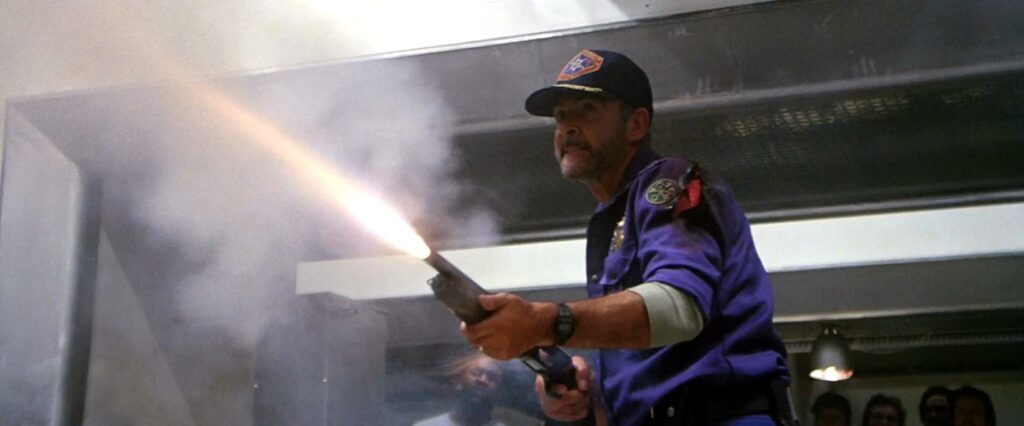
Outland is a western, just on a future frontier. Con-Am 27 is essentially a western town in space, and it didn’t fully dawn on me until the film’s second half that all the tropes are there. O’Niel is the sheriff, gold has been substituted for titanium, there’s the jail and the seedy bar complete with saloon doors, the local criminals and the outside influence. Characters even use shotguns, not blasters or laser guns. It’s Deadwood in space, and no doubt helped inspire the jewel in Star Trek’s crown: Deep Space Nine. We even get the curmudgeonly doctor, played wonderfully by Frances Sternhagen, who rises to help O’Niel after initially being annoyed she’s asked to do more than her usual job: making sure the local sex workers are free of syphilis.
The film might begin as Alien but it ends as High Noon, the film’s third act being a clear homage to that classic western. A ticking clock narrative with a space shuttle taking the place of the train bringing some dangerous criminals who want to kill O’Niel into town. The film gets its conspiracy plot quickly out of the way and the second half is a straightforward, muscular action thriller with O’Niel have to fend for himself against killers on the station, with more exploding heads and space suit fistfights than most westerns. It’s a blast.
As with Alien, Outland was produced by Alan Ladd Jr, a pivotal producer of science fiction movies during this era, also famously being the only man willing to take a chance on George Lucas and Star Wars. Yet Outland has been forgotten compared to those landmark films, and deserves better than its current standing. I certainly wish I’d seen it earlier. It may not have pioneered this style of sci-fi like Alien did two years prior, and directly took plot points from decades old westerns, but Outland still added to the conversation about designing the future. It predates Blade Runner and expanded on the ideas of Alien rather than just copied them, even giving back to that franchise when Aliens took inspiration, and even sound effects, from Outland five years later. It’s a key part of the collaborative back-and-forth era of movie making that helped define science fiction to this day.