The Final Standalone Episode of The Clone Wars has a Huge Star Wars Legacy
From the guest stars, character debuts, and locations, a random standalone episode of The Clone Wars has had massive influence over the franchise in recent years
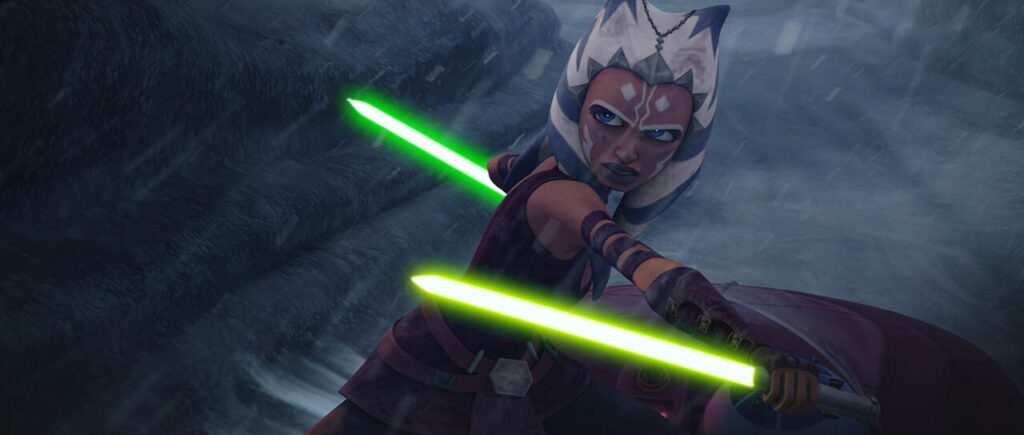
By the fourth season, Star Wars: The Clone Wars was a very different show to the one it began as. Aging up with its audience, the series grew darker and more complex, opting for multi-episode arcs. The single, standalone episodes became fewer and fewer until there were none at all. The last of these one shot stories is A Friend in Need, sandwiched between the Zygerrian slavers arc and Obi-Wan’s undercover arc, two big rich storylines. Yet on my latest rewatch it stuck me that A Friend in Need, despite being just a single 22-minute episode, has an incredible legacy, informing so much of the franchise that has come since.
A Friend in Need is not the episode you expect. From the narrator’s intro and the opening scene, it appears to be a Padme-focused political episode. Mandalore has been chosen as neutral ground for the first official meeting between the Republic and Separatists. That’s a huge moment in the war and easily could have been the backdrop of an episode, if not an arc, itself. But no, the episode soon diverts and goes in a very unexpected direction.
However it’s worth noting that Mon Mothma appears at this conference on Mandalore. After Andor, it’s fun to keep an eye out for Mon’s brief appearances throughout The Clone Wars. The animated series reuses its character models as often as it can and so whenever there’s a political scene, no matter the location, they put Mothma in the background. I love thinking about how the character in the tense political family drama scenes of a prestige live action show was, just a few years earlier, on Mandalore, or at Obi-Wan’s fake funeral, or facing off with the Zillo Beast outside the senate.

A Friend in Need is an ‘and then…’ story, told almost like a child would tell a story. I don’t mean that in a negative way, I think it’s good fun. Structurally, the episode reminded me of The Phantom Menace, which is very linear and introduces key aspects and characters only when our lead characters literally bump into them. Would it have made sense to introduce Anakin a little earlier in that film, cutting back to him while Qui-Gon and Obi-Wan are still on Naboo rather than waiting until act 2? Probably, but it gives the film a serial adventure feel.
This episode is the same way. Suddenly Lux Bonteri interrupts the meeting accusing Dooku of murder and then is dragged away to be executed, and then Ahsoka is the lead character and rescues him, and then it was a ploy to find Dooku’s location, and then Ahsoka and Lux escape on a ship, and then Lux goes to Carlac to team up with Death Watch, and then Death Watch are the key focus of the rest of the episode as Ahsoka brings then to justice. The themes and ideas are consistent but Lux and Ahsoka’s adventure ends in a very different place to where it began.
Carlac is a random planet far from anywhere important to act as an effective hidden base for Death Watch yet will actually appear again in the first episode of The Acolyte, the ice planet where Osha’s prison ship crashes. The location is just the first aspect that will later reappear in modern live action Star Wars. A Friend in Need is directed by Dave Filoni himself and acts so much like a template for his corner of Star Wars. So much so that if he didn’t personally direct this episode I wonder how different The Mandalorian and that sub-franchise would be.
Lux wants to make a deal with Death Watch, use them to take out Dooku. To make it clear he’s making a deal with the devil, the episode paints the Mandalorian sect as villains like never before. They slaughter an entire innocent village of native people and there are references to them taking women from the village. Rape and genocide is a lot for a kids’ cartoon, and Death Watch are sexist in a way characters in Star Wars, even the villains, rarely are. Although a clue to them maybe not being the nicest people is in the name. Come on, Lux, they’re called Death Watch.
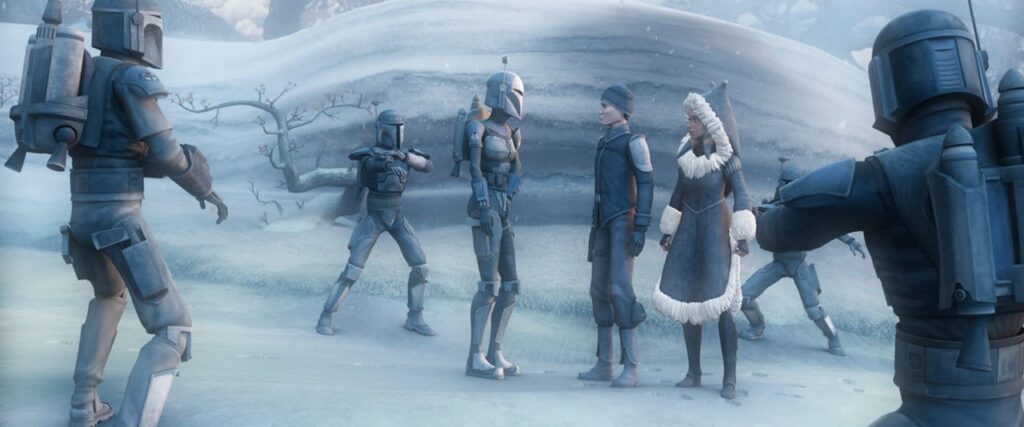
The members of Death Watch we meet are very notable. The leader is Pre Vizsla, who is voiced by Jon Favreau, and the episode also marks the franchise debut of Katee Sackhoff’s character Bo-Katan. Vizsla wields the darksaber at this point. So, let’s get this straight: the protagonist Ahsoka, who will get her own live action show, is facing off against Pre Vizsla, voiced by the eventual creator of The Mandalorian, who is the leader of a Mandalorian group connected to the characters seen in The Mandalorian, who uses a weapon that will be a huge part of The Mandalorian, and also Bo-Katan, who will appear in multiple shows including essentially being the lead of The Mandalorian season 3, on a planet that will feature prominently in The Acolyte, directed by Dave Filoni, who is a creative force behind The Mandalorian. This episode is ground zero for so much stuff in the Mandoverse and beyond.
It may be one of the richest and most important episodes of The Clone Wars but only when viewed in retrospect. Part of the fun is seeing that Filoni and the other creatives had no idea this stuff would be so important. Bo-Katan is only named in the credits and has just a couple of lines of dialogue. If they knew of her arc beforehand, becoming a much more heroic character and friend to Ahsoka, I wonder if they would have played her as such a villain here? She takes part in the massacre and, upon first meeting Ahsoka, makes a comment about her weight and slaps her on the arse. If the two ever meet again in live action, all I’m going to be thinking about is the spanking. And the darksaber at this point is just a weapon, no backstory or importance to Mandalore. They needed a weapon that could withstand hits from a lightsaber and so this is what they came up with, a purely practical creation.
And the point I want to end on is that the episode may be fascinating as a precursor, an origin, of so much Star Wars storytelling to come, but it shouldn’t be lost that it’s a great episode of The Clone Wars and doesn’t lose sight of Ahsoka’s arc in that show. It allows Ahsoka, after seasons of being the pupil, learning lessons not only from Anakin but other characters like Tera Sinube, to be a teacher to Lux. It highlights her growth. The two make a great pair, him an outcast from his side of the conflict just as she soon will be from her’s. Two people trying to make a difference in a game they’ll discover is rigged at a galactic scale, able to see what most cannot. Well, that, and the episode has Ahsoka decapitate four Mandalorians in one move, so that’s pretty cool, too.