When Hellraiser Went To The Past, Future, And Space All In One Messy Movie
Hellraiser: Bloodline is a bonkers mess of a movie, bursting with ideas and butchered in post production

Space. The final frontier for horror franchises that are creatively dead, from Critters to Friday the 13th. But Hellraiser got there first (although only a couple of months before Leprechaun 4: In Space.) Usually shifting the location to such a huge degree is a sign that the formula has become exhausted, the franchise gone stale and in need of a major shakeup, that everyone has run out of ideas. Yet Hellraiser: Bloodline is not a failure because it has no ideas, it’s a failure because it has far too many.
Released in 1996, the fourth film in the series had a troubled production. Budget cuts and meddling from the Weinsteins at Dimension Films led to screenwriter Peter Atkins leaving during filming (after being forced to make a huge amount of changes) and director Kevin Yagher being replaced for reshoots and re-edits, with him ultimately asking for his name to be removed from the credits. Yes, Bloodline is an Alan Smithee joint, which is never a good sign. The final result: an ungodly, bonkers mess of a movie.
The film has a concept that, even if made by a consistent creative force with a clear vision, is doing a lot and easily could have tumbled out of control. The studio interference only ensured that it did so spectacularly. If a camel is a horse designed by committee then Bloodline is one mighty ugly camel, but it’s not like it was guaranteed to be a prize stallion anyway. A long way from the small original film set in that quaint English house (that the sequel retconned into being in America somehow) Bloodline was designed to be the huge conclusion of the series.
Clive Barker was involved in the conceptual stage of the sequel, pitching a film that serves as both prequel and sequel to tell the tale of the beginning and end of the franchise. The film’s three acts are almost three different short films, following different generations of the same bloodline. The first in 1796 Paris as toymaker Phillip LeMarchand creates the Lament Configuration, the second in 1996 New York to follow up the events of the third film, and then the third in 2127 aboard a space station, where the toymaker’s ancestor has to end the family curse and defeat the cenobites for good. It’s… a lot. And while I think Atkins is a talented writer (I’ve written before about my love of the third Hellraiser film) I think he’d bitten off more than he could chew.
The issue with three 30-minute films in one is that there are three films worth of ideas and not enough time to pursue them all. It’s a busy, confusing mess, made worse by the reshoots which move the opening of the future section to the start and an interrogation scene between the acts. Ideas are raised, concepts introduced, and then the film quickly resets to begin again and not develop much of anything. The locations and time periods and styles change, as they should, but unfortunately so do the core themes and ideas. I guess it’s about generational trauma, making it quite ahead of its time, but that’s not clear in the end result.
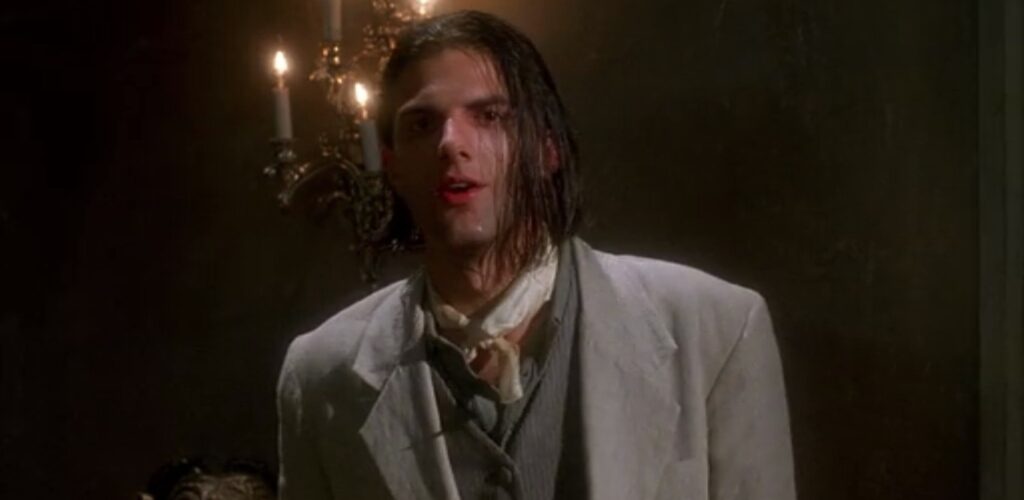
The first act is by far the best. A Hellraiser film set during the French Revolution? Sure, why not. It’s certainly an age of depravity and excess; I’m sure the Cenobites were keeping an eye on the Marquis de Sade. Yagher, a first (and only) time director does a decent job with the visuals of this era, with the shadowy mansion suddenly lit blue as the portal opens, and I always enjoy a split diopter shot. The effects are good, especially the empty skin filling up as a demon possesses a corpse. Angelique is a new and engaging villain, played by Valentina Vargas, who looks like a 90s Noomi Rapace, and even Adam Scott appears in his first film role. It’s a really fun Hellraiser short film.
Then it all begins to fall apart in the second act. I know that the ‘sins of the ancestor,’ a generational curse, is the point of the story but that’s only interesting for the first and last of the LeMarchand/Merchant family members. The middle Merchant, John, is so uninteresting. He neither created the box or will destroy it, so there’s nothing for him to do plot-wise or thematically. The interesting thing about Hellraiser characters is their pull towards darkness, their inner want to see beyond the veil, temptation and desire, and yet John is purely targeted because of someone else’s actions. The middle act is devoid of any deeper thematic or character work whatsoever. It doesn’t help that actor Bruce Ramsay delivers not one, not two, but three bland performances as John, Paul, and Ringo George Phillip, three generations of Merchant. An army of Merchants, or considering the space ship, a Merchant navy, if you will.
So the protagonists of the second act are completely dull because none of them want anything to do with the puzzle box, the location is just New York again which we already saw in the third film and is boring compared to 18th century France and 22nd century space, and it ruins the villains, too. With the Lament Configuration now ludicrously easy to open (literally just a press of a button) Pinhead makes his first proper appearance 45 minutes in. Of course I want to see Pinhead, this is a Hellraiser movie, but he immediately overshadows Angelique to such an extent that it makes the first 45 minutes seem like a waste of time.

Why develop this new villain so much when she gets turned into a Cenobite and becomes just another lackey for the rest of the film, with Pinhead dominating? I wish Angelique remained the lead baddie with Pinhead as this third party who could move from antagonist to almost ally if his goals aligned with Merchant’s, like in the first two films. We get one scene of that, where he acts almost as a consultant to Angelique, guiding yet warning her in their first meeting. Like a spiritual advisor for demons. But then he takes over completely; you can’t put Pinhead back in the box once he’s released. At least Atkins gives him a couple of great lines.
One of many ideas the film is stuffed with, yet only gets to spend a couple of minutes on, is John’s young son and innocent wife being targeted. This is the best aspect of the second act and I wish got more focus. A Hellraiser film from the perspective of a child, thrown into this horror world of sex and violence without understanding, would be fascinating. It’s thematically rich and a neat metaphor. It’s like Fatal Attraction but with Cenobites in the Glenn Close role. A husband’s dalliance with the Lament Configuration coming back to haunt not only him but his innocent family like the consequences of an affair.
And then we get the third act which is an almighty disappointment. Cenobites hunting people on a spaceship? Sounds good but this isn’t the Nostromo. The slashed budget means that the Minos space station is little more than a dingy warehouse. If it wasn’t for an establishing shot in space you’d think it all takes place in an abandoned industrial estate. The villain motivations are now simply ‘kill everyone for no real reason’ and the cenobites and kills are poor. Angelique is barely involved and Pinhead is tricked with holograms (like the end of Star Trek: Insurrection) in a way that makes him look like a moron. I can’t believe how dull they manage to make BDSM sex demons killing people on a space station. And the bland cast of space soldiers are a long way from the colonial marines of Aliens. Although, one is called Parker in a clear nod to Alien and another Rimmer, which is probably a Red Dwarf reference although knowing Hellraiser could also be her fetish.
The recent 4K remaster and rerelease of Hellraiser: Bloodline from Arrow Films comes with a previously unseen workprint version of the film, but it’s not the revelatory experience fans were hoping for. It’s a messy middle ground between the script and the reshot theatrical cut, with incomplete effects and scenes from a VHS. I’m eager to read Atkins’ script, now available in paperback, even if it’ll make me lament the butchered version of the film we got even more. Maybe the pain isn’t that we missed out on one good film, it’s that we potentially missed out on three good films in one, but I can’t help feeling that it would have been confused jumble anyway.