10 Years Later, Firewatch Remains a Beautiful and Powerful Game
A decade on and Firewatch might lack some interactability but the visuals are stunning and the narrative rich and powerful
Firewatch was one of those perfect indie game experiences. I played it over a single weekend in February 2016 and hadn’t touched it since, yet it left a huge impression. Every now and then over the past decade I’d think about it – a scene, a moment, a character, a location, a vibe. When I tear myself away from whatever massive AAA game I’m working my way through, with my limited playtime making each game last about four months, and play a smaller game over a weekend, Firewatch is the experience I’m comparing it against, hoping it lives up to. But all I’ve had for ten years now are memories of that experience. To celebrate the game I thought I’d revisit it and see how it holds up, both as a game and as a specific personal experience.
I’ve certainly aged as a gamer these past ten years. Where once I would leap and bound across the environment, which in Firewatch is Shoshone National Forest in 1989, now I find myself trepidatious. Interacting with every ‘long drop down’ in the game gave me a queasy feeling of ‘oh, I could easily sprain my ankle here.’ I never really thought of Firewatch as a walking simulator but I guess at its gameplay heart it is. It certainly is how I play it in 2026, casually strolling and keeping jogging to a minimum. For a game that involves trekking the same area again and again I was never bored, despite on revisit the game map being much smaller than I remembered. It’s easy to learn your way around to the extent the in-game compass seems almost like a joke inclusion.
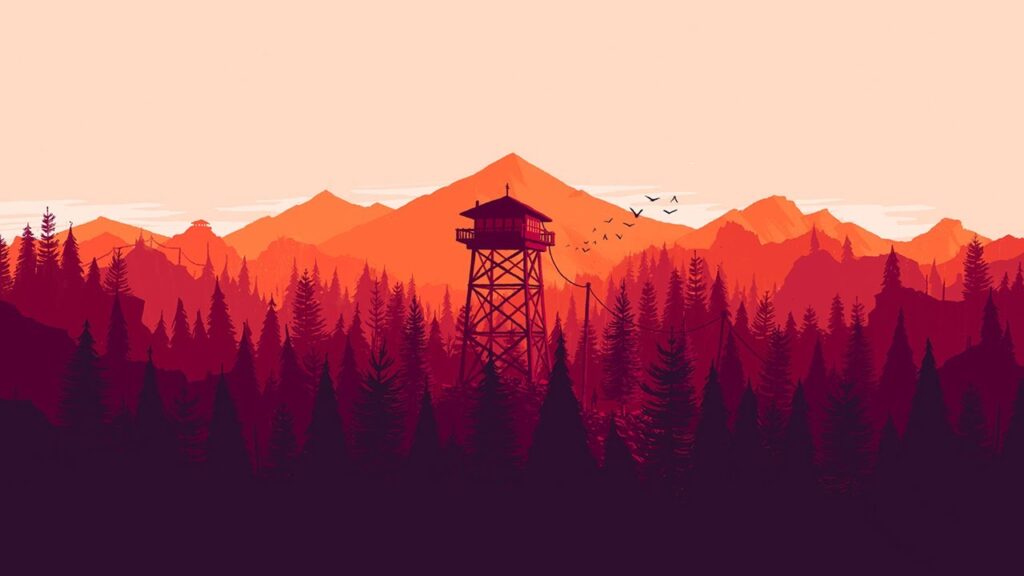
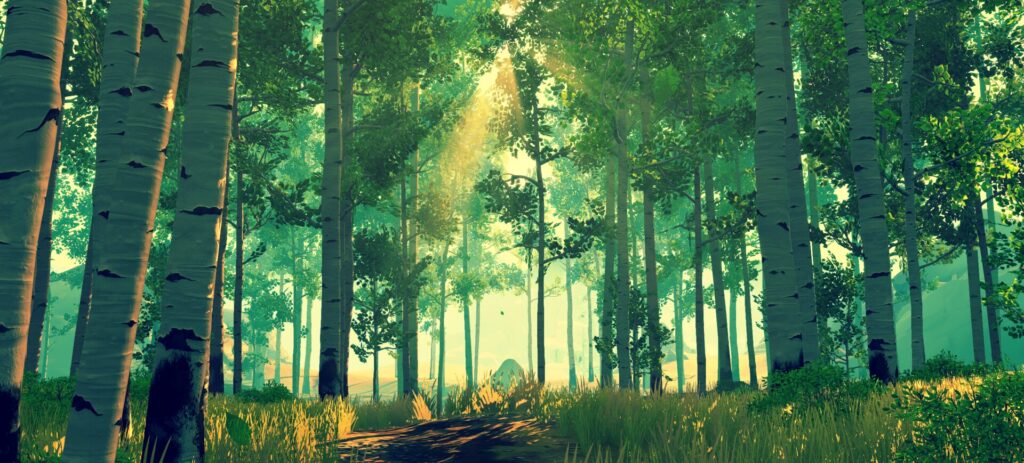
There’s certainly a plot, a mystery to get invested in and propel characters forward, but replaying Firewatch was a meditative experience more than anything. The opportunity to walk through Wyoming without having to get on a plane and go to America, a proposition less appealing each day. The feel of it, the tone and vibe, is wonderful. And it’s still a beautiful game. The visuals have aged well because they aren’t trying to be photorealistic, it’s a specific design. I didn’t realise, or more likely had forgotten, that Olly Moss was involved in designing the game itself rather than just the key art. It’s stunning.
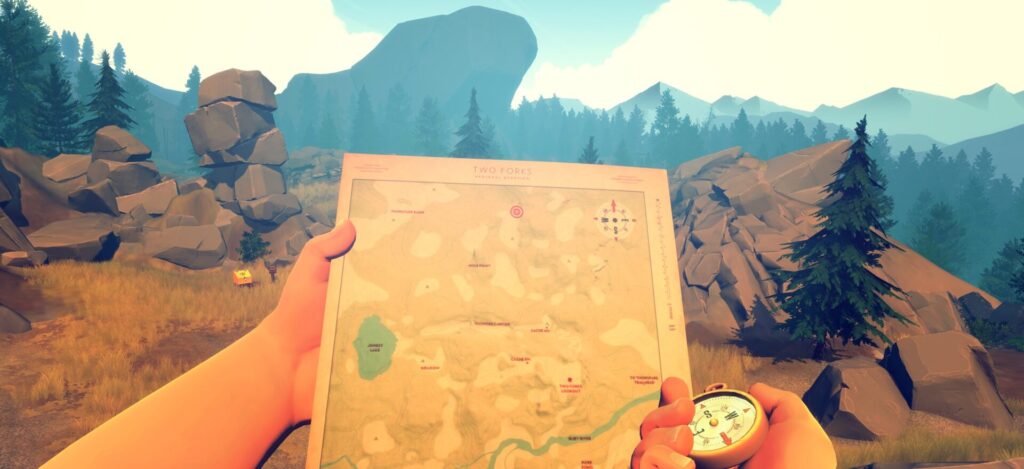
In particular the early morning feel of the beginning of Day 2 is so brilliantly portrayed. The damp, verdant forest dimly lit before eventually warming up, the progression of the day presented through lighting. Although I think it may get a bit too orange in the evening; I’m pretty sure my OLED TV has permanently damaged my corneas. This stunning environment makes for relaxing gameplay where I just want to explore and look around (I’m grateful for the free roam accessible after the story) but it also makes the tense and scary moments work so much better by contrast. The peaceful world suddenly interrupted: one moment you’re enjoying a walk in the woods and the next there’s a burnt cabin with the wind howling through its remnants.
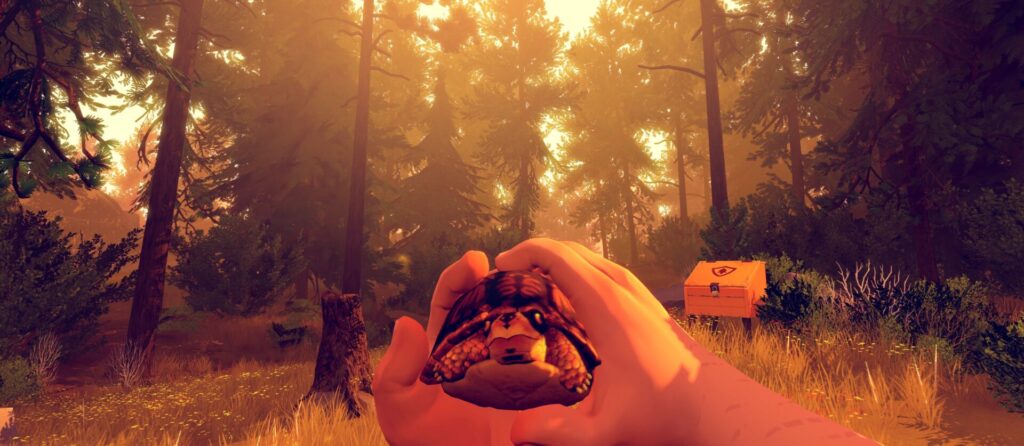
Playing today, I do feel the lack of interactability. The story and themes are rich and dense but the gameplay is limited, at least from a 2026 perspective. I’m not saying I wish I could take a shit in the outhouse or swim in the lake but, for instance, there’s a cairn you can find and stone you can pick up but no option to add the stone to the cairn. I want some of that Assassin’s Creed: Valhalla cairn action. There’s a tortoise that can be adopted but by ‘adopted’ it means pick up and keep in a box. There’s no option to feed it or anything. The only thing you can do is accidently drop off the tower (sorry, Shelly Duvall). Although I liked the few completely optional actions I could undertake to enforce my interpretation of the game’s themes: I dramatically (and unsubtly) threw a bottle of whisky from the tower and kept turning up the photo of Julia every time I found it face down.
I do question whether the long intro to the game, selecting text options to build Henry’s backstory, is needed. Most of this information is revealed as the game progresses anyway through conversations between Henry and Delilah, but I guess the player needs to know everything immediately so they decide exactly what to share. It’s the kind of thing not needed for a film but to give the player agency I think it’s ultimately necessary for a game, if a little clunky.
But that’s pretty much where my criticisms relating to the story end. I think the narrative is excellent. Henry, a man whose wife struggles with early-onset Alzheimer’s, retreats from his life to work for the Forestry Service, spending the summer isolated in a tower watching for fires, communicating only with his colleague Delilah over the radio, before finding himself in what could be a murderous conspiracy. Keeping the characters apart, Henry never interacting with anyone face-to-face over the entire game, is a brilliant decision. It sells his loneliness, his feeling of being adrift, and turns the game from relaxing ramble to paranoia-filled horror. Yet despite the lack of human interaction, so much is conveyed about the characters. It only works because the writing and voice acting are so strong.
Fire, it turns out, is a pretty good metaphor. Henry just wants a nice life but his is wrecked by this unseen force he tries to run from but it’s never going to stop burning. He has to accept and confront it. At least, that’s part of what I took away from the game. Firewatch does an outstanding job making its story, ideas, and themes specific yet interpretable in different ways. What it’s about, what the conspiracy and revelations actually mean from a character perspective, are arguable. I love how the events and locations reflect Henry’s life and inner turmoil: he searches for the careless young teens while relaying the early days of his relationship with Julia, and then he discusses her diagnosis while walking through a ravaged burnt area.
But away from the wider implications, it’s just a fun story to experience. I had actually forgotten what the actual story was so it was fun to be surprised by the same things ten years later. In fact, I think I was expecting to be disappointed. Over the decade I had replaced my own opinion with the opinion that I’ve seen pervade online, that’s it’s a fun game but the narrative has an abrupt and unsatisfying conclusion. I disagree completely. I understand that some people would be more obsessed by the conspiracy. There are so many potential paths the story could have gone down that players could be annoyed not everything pays off in perhaps the scale expected. At times, Firewatch teeters on the edge of huge conspiracy, crime thriller, sci-fi, supernatural, or psychological drama. There was a point I was expecting Delilah to only exist in Henry’s head. But ultimately I’m satisfied. I think the story is fittingly small and personal in the end.
I love that other players will take different lessons from the game but for me it’s clear. The woods are an escape for Henry, he’s running from a problem. It’s up to the player to decide, considering the circumstances, whether it’s a needed respite or a selfish running away. Personally, I err towards the latter. All the characters in the game are likable but flawed and messy. Ned is a darker version of Henry, crippled by a failed relationship with a loved one and venturing further into the heart of darkness of the woods. Delilah is likewise another warning, spending a decade hiding from her problems, lying about them. I love how her character is handled: she’s charming but a clear liar, yet not maliciously because she’s lying to herself as much as Henry. For me, the game is about Henry having to leave the woods behind, he can’t hide in this “pause in the hallway of time”, and return to care for his wife. For others, it can be a romance where Henry and Delilah fall in love. The fear of conspiracy was always an internal struggle than something real and external. There’s no easy catharsis.
But that’s just a broad understanding of the game’s core ideas. There’s so much else going on under the surface. It’s terrifically written, a rich and powerful game touching on so many topics. I think there’s a whole running theme about gender expectations. Henry is man who has found himself impotent in the wake of his wife’s diagnosis. A big strong man threatened by something he has no control over. He can’t protect his wife. So he retreats into the woods, living a harsh existence by myself like a big strong man does. Only he’s the target of attacks, spends much of the game scared, and has a woman telling him what to do. Even in the intro, one of the first choices the player makes is whether to poses in a masculine or feminine way. I think it’s just one of the many threads running under the surface quite subtly. Well, subtle other than the brand name on his Thermos being “Manly.”
I feared disappointment revisiting Firewatch and so I’m relieved it has stood not only the test of time but also my old nostalgic memories of that now distant weekend playing it for the first time. It doubles the pain knowing this is the only game Campo Santo produced. Soon after the studio was acquired by Valve and is now essentially dead, another victim of this horribly managed industry. Thankfully we have Firewatch, aptly standing tall amid the devastation surrounding it. A decade later and it is still a beautiful and powerful experience.