The Best and Worst of Millennium Season 1
The influential sister show of The X-Files stands alone as a dark and disturbing series that succeeds once it leaves behind its comfortable procedural formula
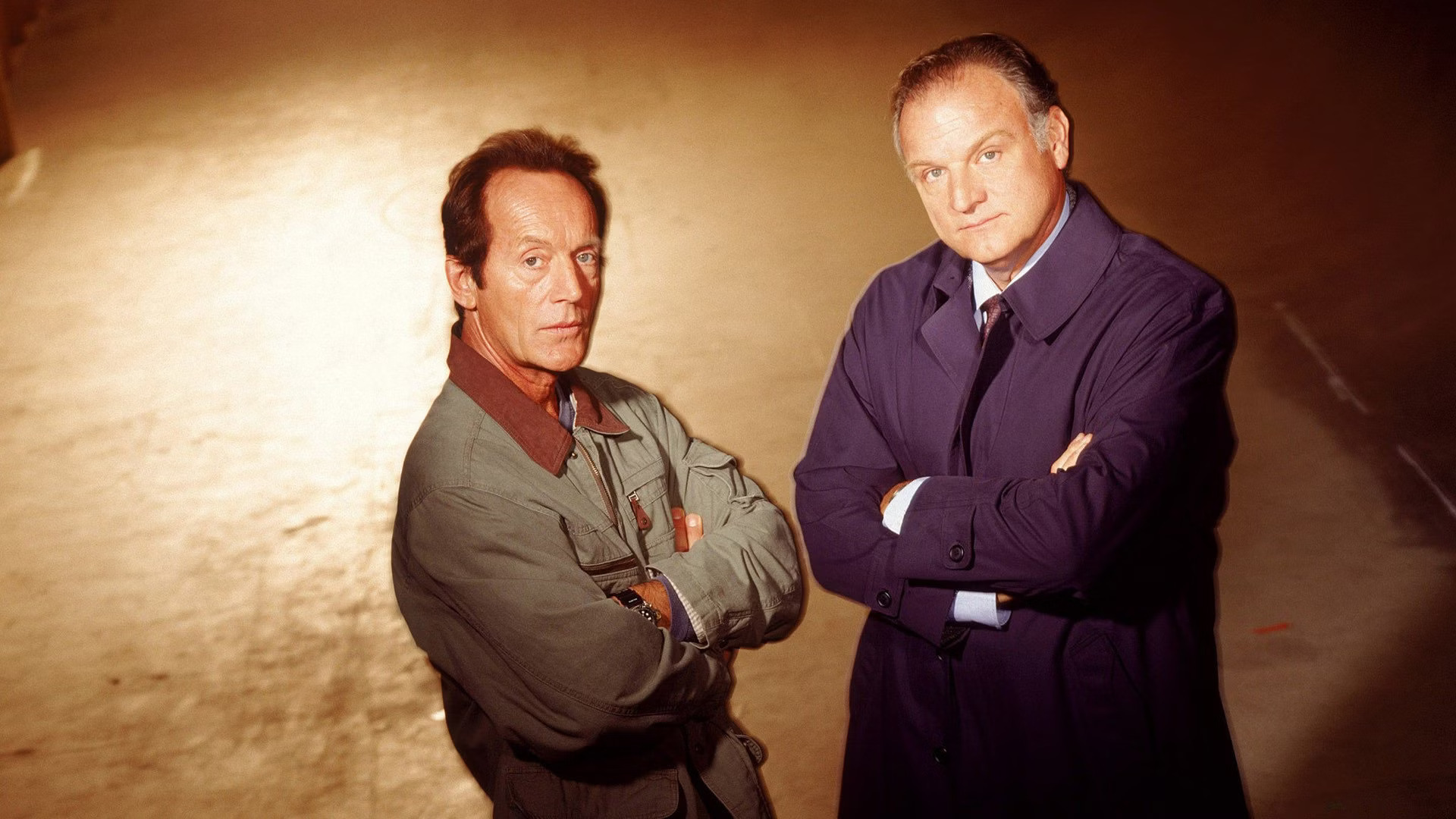
All I knew before watching Millennium was that it’s the sister show to The X-Files. Turns out it’s the weird troubled goth sister who mutters disturbing things, rarely comes out of her black bedroom, and whose parents whisper-argue in bed at night about whether they need to take her to a psychiatrist. Despite so many connections, like sharing a pool of onscreen and offscreen talent, and both being about criminal investigations, the two shows are very different. Tonally and philosophically Millennium is a different beast entirely.
It’s a dark and moody show. So dark. So moody. Millennium centres around Frank Black, an ex-FBI agent who now works in the private sector, part of the Millennium Group, aiding police forces in hunting down serial killers while some grander, nebulous evil threatens society as the millennium draws near. It’s a show which prophecies that the end times are upon us, though has yet to settle on a definitive cause, whether human evil or perhaps religious or supernatural. It’s hard not to see it as a fairly nihilistic series, despite Black ironically being a beacon of light, with society’s failings on display. It argues that we’re at the end of something rather than the beginning, an idea The Sopranos would play with a couple of years later.
The ongoing plot is vague and formless, and the killers mostly have intangible pseudo-psychological motivations, but that barely matters because Millennium is a show about atmosphere, and it’s dripping with it. I mean literally, the show must have kept the rain machine industry in good standing for its three-season run. Creator Chris Carter has said he wanted to make a television equivalent of David Fincher’s Se7en. It’s a big ask but somehow he managed it. It’s darkly beautiful and deeply unsettling, unafraid of showcasing brutality in a way The X-Files rarely did. There’s none of the levity or tonal shifts of that show; Millennium is unflinchingly, relentlessly grim, with a very different soundscape from composer Mark Snow.
It’s very much a cult show, hard to find and watch in 2025. I had to source some out-of-print DVDs on eBay. But Millennium has proved to be very influential. It laid the groundwork for so much television that would come later in the 21st century. Everything from procedural cop shows to prestige dramas. Hannibal, a show I love, was clearly influenced by Millennium, with Will Graham being as much Frank Black as he is the character from Thomas Harris’s Red Dragon. And it’s shocking what Carter and his team managed to get away with on network TV in the nineties. It’s still disturbing in its violence and threat and the darkness that permeates throughout.
The tone, atmosphere, and ideas of the show are there from the start, laid out in the excellent pilot episode, but some of the plotting and narrative elements remain undefined for much of the season. Carter never has a grasp on what the overarching mythology of the series is. After finishing all 22 episodes I still don’t know what to make of the Millennium Group. They are a collective of private detective consultants, all ex-law enforcement, who the police never question and allow to do their jobs for them. In most episodes it feels irrelevant that Frank is a member; you could be forgiven for thinking he was still an FBI agent. Some of my favourite episodes paint Black more as an archetypal wandering stranger, travelling the land as a beacon of truth and morality, sharing and spreading what he can in some existential battle against a greater darkness and evil.
But regardless of his job description, Frank is a great protagonist. The entire series rests on his shoulders, not shared across two like the weight of The X-Files was. He’s initially seemingly quite one-note, continually grim and serious, a detective aided by psychic visions, but Lance Henriksen is excellent at hinting how much more is happening underneath the cool exterior. It’s a much more subtle portrayal of a man struggling with the darkness of his work than other similar stories and very effective for it. Unfortunately, for much of the season, Frank’s wife Catherine and daughter Jordan are little more than that: his wife and daughter. Trapped in those roles, they are more symbols in Frank’s life than characters, adding some light to fight for and protect.
In the overwhelming darkness of Millennium there is one ray of light: the yellow house. If most of the show is Hannibal, the scenes at the house are Pushing Daisies. Frank’s family home is presented as very bright and colourful, shot in high contrast, especially compared to the sepia tones of the rest of the show. It’s all sunshine and rainbows and smiles and nuclear families, complete with a dog. I wasn’t sure about this at first, that it’s played as far too saccharine in the opening episodes, but I think that’s the point. This place is a utopia by its original definition: unobtainable. It’s a lie, a façade Frank is desperately trying to keep his family contained within, away from the world’s evil. But he knows the colours here too will fade. And in the season’s best episode the house is breached and the light flickers, if not goes out entirely.
Millennium does rely on very formulaic storytelling across the first half of the season as it figures out on the fly just what stories the show is capable of telling. Those initial procedural ‘serial-killer-of-the-week’ instalments make for some of the weakest episodes of the season but the series never totally flounders, that dark brooding tone is sufficient enough to support a couple of weak, repetitive scripts. By the season’s second half, Millennium truly finds its feet and is a much more flexible show, able to find new ways to tell serial killer stories that challenge Frank and the show’s ideas in fresh ways. There are more mystery stories in the back half of the season, delving into concepts of evil and dabbling with the supernatural, rather than sticking purely to Frank chasing human evil, personified by a killer we follow almost as a second lead until they collide with Frank like those that dominate the season’s first half. As the season comes to a close, it’s willing to more freely experiment and I’m excited to see where the series can go in the next two seasons.
Underrated Episode: Dead Letters (S1E3)
Not being as popular in the zeitgeist or as frequently discussed online as The X-Files, it’s hard to judge which episodes of Millennium are generally liked or disliked, so I’m naming Dead Letters underrated based on IMDB scores and the few reviews I can find. It’s the first script by Glen Morgan and James Wong and does wonders for Frank as a character. Because he’s so quiet and stoic, Frank is a challenge to characterise and get to know. Therefore the episode pairs him with another detective, Jim, brilliantly played by James Morrison, who struggles with the darkness of the job. In showing us how he fails, we contrastingly see why Frank succeeds and is good at his job. It’s characterisation by proxy, and cleverly done.
Dead Letters is the story the show needed at this early stage. Frank’s past mental breakdown has been mentioned but here we see what it must have been like through somebody else. Jim makes it all too personal, the killer getting in his head rather than the other way around, whereas Frank is able to maintain that vital distance. Just. The serial killer plot is solid, as good as it needs to be, but takes a backseat for what is truly a character study. There’s even a sprinkle of dark comedy, a rarity at this stage of the show, with Jim seeing the killer everywhere, his truck replacing every car on the street, and even a disturbing dream sequence thrown in for good measure. It’s a great episode and the one that got me hooked on the show.
Biggest Disappointment: The Judge (S1E4)
The Judge is the first miss of the series. A story about justice which the show, ironically, doesn’t do justice. The concept is strong but is left frustratingly underexplored. The killer, or small group of killers, deliver their own brand of justice outside the law, striking down bad people, similar to the concept of later series Dexter. That’s a great idea, ripe for comparison with the Millennium Group itself, a fellow private enforcement group with questionable authority and jurisdiction, but Frank never seems conflicted by that idea. Instead the episode focuses too much on the standard procedural elements, the basic mechanics of the plot rather than the themes. What makes it all the more disappointing is that it’s written by Deadwood’s Ted Mann, who is capable of great work, and even stars two Deadwood actors in John Hawkes and Marshall Bell, who dispose of bodies by feeding them to pigs, no less. The Deadwood fan in me loved the details but was disappointed with the substance.
Best Catherine Episode: The Well-Worn Lock (S1E8)
This is the first time Frank’s wife Catherine is more than just Frank’s wife Catherine. The Well-Worn Lock backgrounds Frank and pushes Catherine into the lead role, with the episode focusing on the difficulties of prosecuting child sexual abuse rather than the standard fare of tracking down a serial killer. It’s a different form of evil, one which makes for the most unsettling episode of the season, and perhaps the boldest, too. It does so much for a 90s network show, unable to use words like “incest” and “paedophilia.” It’s hard to watch, and highlights how we’ve come accustomed and desensitised to murder on TV but not other heinous crimes. It’s not a subtle episode but it is powerful, and its heart is in the right place. The Well-Worn Lock does threaten to make Frank the lead halfway through when it becomes a missing persons investigation but thankfully this is only for a brief time. Much of the episode deals with the female characters, the survivors and wife of the abuser who is trying to keep it a secret, and so it’s perfect for Catherine, who is written as a competent and empathetic protagonist, fleshing her out far more than other instalments.
Worst Episode: Wide Open (S1E9)
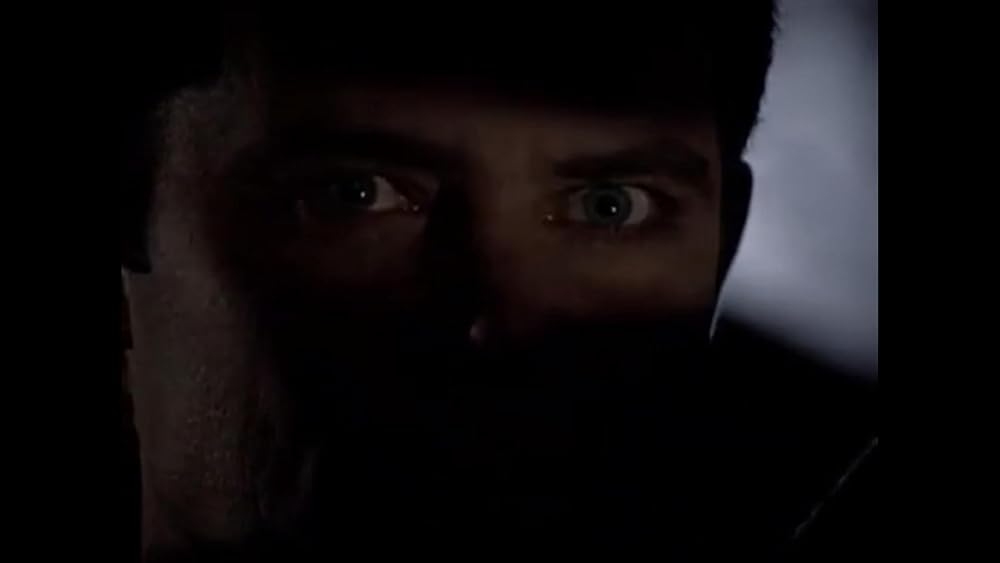
By this point in the season’s run, the goodwill created by the brilliant pilot is wearing thin and the show has yet to reenergise itself like it will in the season’s back half. Millennium is currently a dark and disturbing yet very formulaic procedural, and Wide Open is perhaps the most formulaic episode of the bunch. Everything it does the surrounding episodes are also doing, better. It’s the dullest episode and I’d take an actively bad script (like Loin Like a Hunting Flame) over one as boring as this. I write this a few days after watching it and I can barely remember the details.
A bug-eyed white man stalks a family and kills them, which could be a descriptor for any episode this season. The only notable detail is he sneaks into homes during an open house session by a realtor, which makes for an effective cold open but isn’t a premise that supports an entire episode. There are some massive leaps in logic during the investigation. Given Frank’s quasi-psychic abilities I expect him to put two pieces of information together in seemingly impossible ways but not other investigators. Here we get a scene with a handwriting analyst who can tell just from the way the killer crosses his t’s and dots his lower case j’s that he’s prone to outbursts and violence. It’s ludicrous, as is Frank’s Blade Runner-style ability to zoom in to photographs to an impossible level. The killer’s psychology is so shallow the script has to fall back on gimmicks like this to catch him.
It’s an episode of Millennium without a mention of the Millennium Group, the concept of the show, and so it plays as a straightforward generic cop show where Frank could be any detective. The one intriguing moment of darkness comes from Frank’s police buddy refusing to call the paramedics for the dying killer so Frank has to do so, which comes out of nowhere and the show is uninterested in the implications. And this is preceded by the killer goofily being pushed down some stairs by a family dog, making the police work meaningless. Wide Open features the most generic of killers, nonsensical detective work, few specific identifying features of Millennium over other cop shows, and a lame finale, making it the worst episode, or at least the most boring episode, of the season.
Worst Final Scene & Wasted Guest Star: Harriet Harris in Loin Like a Hunting Flame (S1E12)
Loin Like a Hunting Flame is one of the weakest episodes of the season yet also one of the most interesting, too. There are ideas crying out to be explored but the execution fails. Frank is tracking down a sexually frustrated killer, who after an 18-year sexless marriage is targeting, drugging, and killing sexually liberated people. It’s a bold choice and perhaps the one topic the show has tackled this season that it can’t do justice considering the network censors. It’s an episode about sex that can’t depict or discuss sex in any real terms. The perspective of the episode is also very outdated, and must even have seemed socially conservative back when it aired. The final scene has Frank deliver a speech about how society is crumbling, the apocalypse may be coming, and links it not to the killer’s actions like most episodes but the victims, that open sexuality is destroying America. It’s a horrific message to end on.
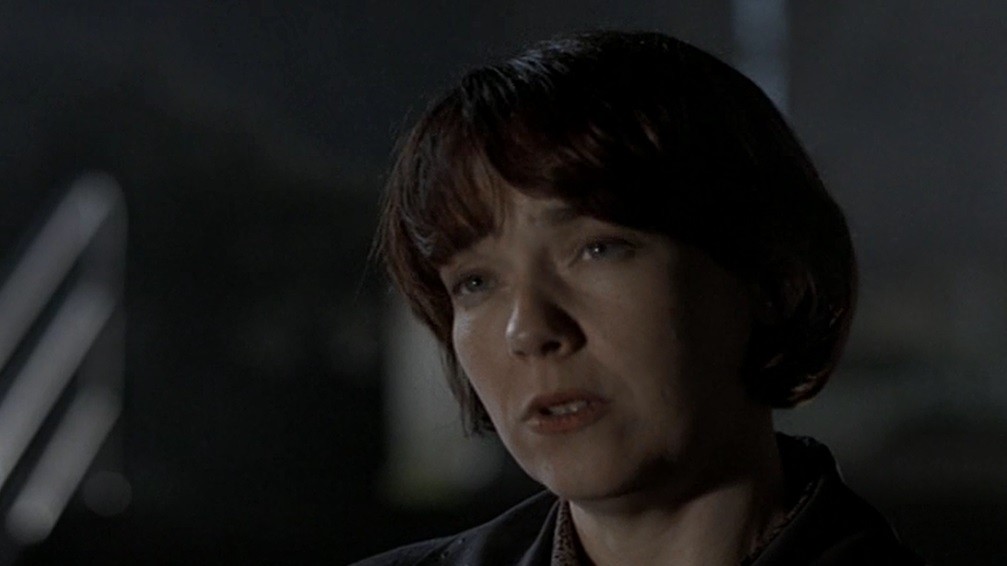
And personifying much of the episode’s issues is the treatment of Maureen Murphy, played by guest star Harriet Harris. Murphy is a member of the Millennium Group, paired with Frank to hunt the killer. It seemingly begins well, with the local sheriff dismissing the need for a woman’s opinion on male sexuality and Frank putting him in his place by saying her opinion needs to be valued. The episode then never values her opinion. Murphy is barely in the episode, with usual cohort Peter Watts stepping in to deliver the exposition that should be her’s, and then there’s another Millennium member who tags along as well as the sheriff. It’s too big a group for what needed to be a two-hander. Murphy is left with only one meaningful scene, interviewing the killer’s wife. It’s a massive waste of Harriet Harris who is so good in The X-Files episode Eve where she portrays multiple distinct characters. Here, she doesn’t even get one.
The ’What the Hell Did I Just Watch?’ Award and Best Guest Star: Brad Dourif in Force Majeure (S1E13)
Force Majeure is an absolutely bonkers episode of Millennium and I think I love it. It marks a serious turning point in the show, finally introducing its own serialised mythology thirteen episodes in. Gone is the serial-killer-of-the-week formula, replaced with something far weirder and more akin to sister show The X-Files. A young woman commits suicide by self-immolation and Frank’s investigation discovers she’s a clone, one of many identical Überfrau bred to survive the coming apocalypse in 2000, caused by planetary syzygy, masterminded by a mad scientist in an iron lung. Every five minutes the episode adds a new preposterous element, with the final scene taking place in a new Noah’s ark. For all the baffling choices, it somehow works. It’s silly but the show’s gravitas and serious atmosphere help the episode from imploding, and I consider it one of the most enjoyable of the season.
The episode also features my favourite guest star of the season, an actor who also appeared memorably in the first season of The X-Files. There are numerous shared cast members between the two shows, including CCH Pounder, Karin Konoval, and that ginger teen girl who recurs in The X-Files getting high in a different way each episode. I was tempted to name Sam Anderson as my favourite guest star because I like to think his appearance as an FBI agent in Millennium is the same character he plays in Everybody Loves Raymond. What a crossover. But who am I kidding, it’s Brad Dourif. He’s always great but he’s perfect for this episode and perhaps even saves it from falling into total insanity. If you’re going to have a character speak absolute nonsense about planetary alignment and biblical disasters then hiring Brad Dourif is an inspired choice because he makes everything intense and engaging: he makes the episode work.
Best Killer: Richard Hance in The Thin White Line (S1E14)
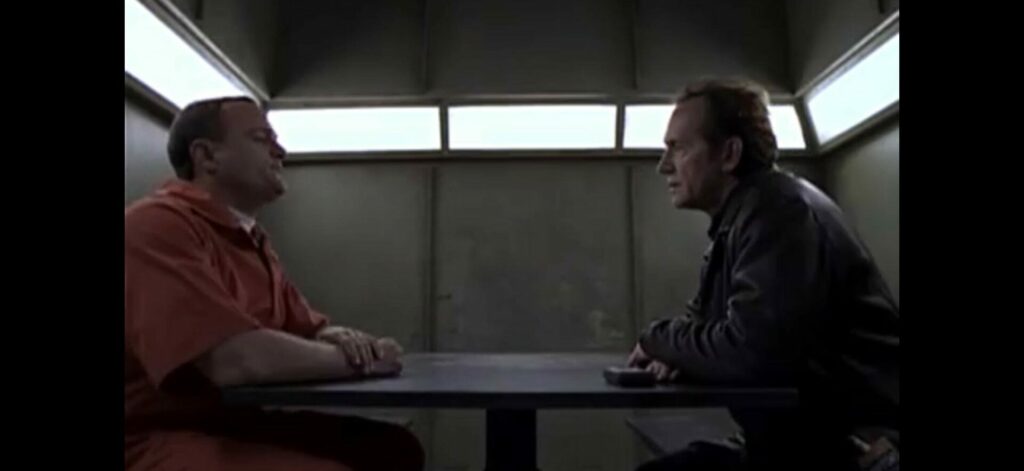
A Millennium episode is only as good as its serial killer and The Thin White Line is a very good episode. While Se7en is often cited as a clear influence on the show, writers Morgan and Wong were clearly inspired by Thomas Harris’s Red Dragon for this episode. Richard Hance, brilliantly played by Jeremy Roberts, isn’t even the primary killer of the episode, with his young ex-cell mate protégé doing the slaying while Hance is behind bars. This allows for some wonderfully written and psychologically dense dialogue between Hance and Frank during a prison interview. It’s tense, with Hance feeling like he could snap and attack Frank at any moment, but not without humour either, with him wanting Gary Busey to play him in a film of his life. The verbal chess between the two is excellent and, as with Hannibal Lector, you can’t help but come to like Hance is a weird sort of way, and even Frank almost feels sympathy for the ruthless killer.
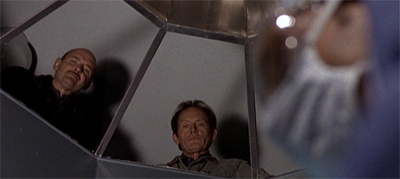
The Thin White Line might use Hance as a psychological villain for the bulk of the story but an extended flashback also allows him to be a physical threat. We see how Frank first met and apprehended him twenty years previous, and it might be the single best and scariest sequence of the season. The slow search through an abandoned building, Hance picking off cops as he separates them, killing three before injuring Frank. Hance appears and disappears into the dark, painting himself with black camouflage. It’s such a moody and effective sequence that shows Hance as a genuinely dangerous character more than most other killers on the show. And the upside down shots of Hance looking down on Frank are chilling. It’s the kind of sequence that made me glad I was watching on DVD, the SD murky visuals fitting the dark scene perfectly.
Best Episode: Lamentation (S1E18)
Finally the show delivers the kind of episode is has been threatening since the beginning. Besides Frank’s quasi-psychic visions, Lamentation is the introduction of the undeniably supernatural to Millennium. It could have been terrible, destroying the very human drama the show has cultivated, or it could open up the series to new possibilities while keeping the same thematic heart. Thankfully, it’s the latter. Lamentation is fantastic. The episode delivers a brilliant subversion, building the beginning around the usual evil serial killer, Fabricant, a despicable human being we assume will be the villain, only to have him be another victim. He’s terrified, begging Frank to run for his life. As opposed to ‘the evil that men do’ being the villain, it’s some unknowable cosmic biblical evil, personified as Lucy Butler, revealed to a shapeshifting demon, although she’s more a concept than a form. At first we think she’s just an acolyte of the killer but is soon revealed to be far, far more.
The story is deeply personal for Frank, with him returning to the FBI for the first time since leaving prior to the series beginning. He’s drawn home, back to his darkest hour, and, despite a blink-and-you’ll-miss-it cameo by Mulder and Scully, FBI headquarters is portrayed as a dark and foreboding place. It’s not the bright offices of The X-Files, and is rather more akin to a killer’s lair. Frank is unsettled as the episode starts and almost at breaking point by the time it ends. He feels guilt over keeping Fabricant alive, saved from the death penalty so the FBI can learn from him, only to escape and possibly endanger more lives. And yet, because he’s alive, Fabricant can save the life of his sister with a kidney transplant. It’s an episode reckoning with ideas with no easy answers, if answers at all.
There might be no more powerful image in the first season of Millennium than the yellow house, the final bastion of light and life, in the pouring rain. The storm has finally come for the Black house. The worlds of the show, despite Frank trying to keep them separate, have collided. The demonic killer comes for Frank’s wife and daughter all while Frank is impotent, across the country sitting by the phone, waiting to learn if they are dead or alive. It’s a great sequence, seeing Catherine in peril, her home invaded by the dark. I’m curious to see how many times the show will play this card. It can’t happen too many times and maintain an impact but it’s very effective here, scary in its inevitability. It’s a brilliantly creepy episode.
While Catherine and Jordan survive, unsurprisingly, the episode does kill recurring character Bob Bletcher. The intro to Lamentation does try to sell the idea of Frank and Bob being friends a little too hard, hiking up a mountain when we’ve never seen them spend time together outside of work before. Bob, despite being played by the brilliant Bill Smitrovich, never worked as well as Chris Carter seemingly wanted him to. Peter Watts quickly became the confidant/co-detective with Frank so while Bill’s death is important it’s not massively impactful to the series. It does effectively raise the stakes however. This is the first episode which can’t simply return to the status quo at the end. Frank’s friend is dead, the exact nature of the crime unexplainable, and the killer on the loose. It’s like a lite version of Deep Throat’s death in the first season of The X-Files. Something has shifted. The sequence of Bob’s death even features a very X-Files music cue for the first time in this series, as if Millennium’s sister show is welcoming it into a new paranormal realm.
The Slightly Lacklustre Final Three Episodes
The one-two punch of Lamentation and Powers, Principalities, Thrones and Dominions is so strong that the following three episodes can’t help but disappoint somewhat. On reflection, they probably should have been saved for the final two episodes of the season, expanding the show into new supernatural realms and heightening the stakes, and so immediately falling back to a serial-killer-of-the-week story results in whiplash. Broken World isn’t a bad episode but it does feel very generic and would fit in more with the first half of the season rather than following up such a paradigm shift. Marantha is solid and plays with some interesting ideas but gets going far too late into the runtime. And then the actual finale, Paper Dove, feels like a lesser version of Lamentation. It has a fascinating and disturbing killer but it tries to clunkily wrap a largely standalone story into the overarching serialisation, finally introducing Frank’s mysterious stalker who hasn’t been relevant since the premiere. Catherine is kidnapped for a cliffhanger ending but it still feels like the drama of the season peaked four episodes prior, and I’m more interested in seeing Lucy Butler again than I am ‘Polaroid Man.’
Five Worst Episodes:
5. The Wild and the Innocent (S1E10)
4. Kingdom Come (S1E6)
3. The Judge (S1E4)
2. Loin Like a Hunting Flame (S1E12)
1. Wide Open (S1E9)
Five Best Episodes:
5. Powers, Principalities, Thrones and Dominions (S1E19)
4. The Pilot (S1E1)
3. Covenant (S1E16)
2. The Thin White Line (S1E14)
1. Lamentation (S1E18)
Millennium is not the spin-off/sister show to The X-Files I was expecting when I began watching. It’s a much more serious, gritty, grounded series but I enjoyed the dark surprise of it. I think it’s largely very good. And as the season progressed it began to evolve, perhaps becoming more like the show I expected, willing to go in strange and possibly supernatural directions without losing its unique vibe or becoming too much like its more popular kin. I’m eager to see its evolution continue. I know Chris Carter steps back from the second season and Glen Morgan and James Wong become the new showrunners, creating a more polarising sophomore outing, from what I hear. I’m shocked that Darin Morgan will write comedy episodes of this show because I cannot see how Millennium will be able to be funny, but I can’t wait to find out. I’ll have an article discussing the very different second season in the coming weeks.