Netflix’s The Thursday Murder Club is a Disappointingly Shallow Adaptation
By trimming red herrings and character-rich subplots, Netflix’s adaptation removes the heart and soul of the novel
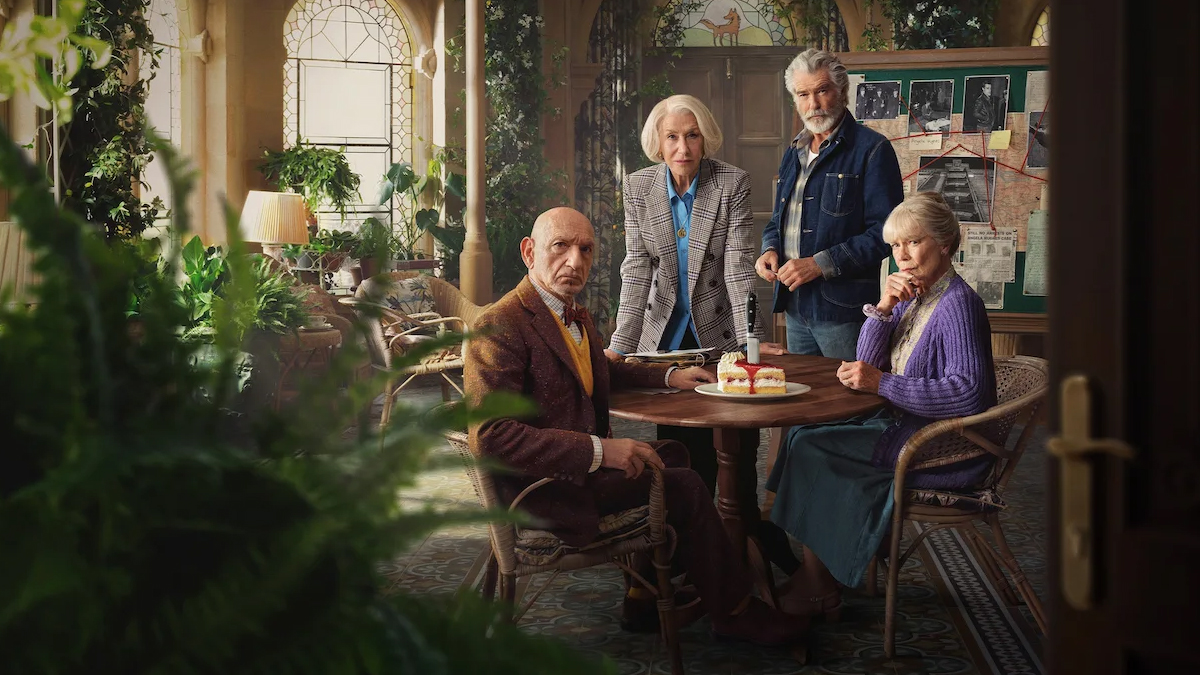
In a landscape of extended, drawn-out murder mystery series clogging up streaming services, shows that could easily have been condensed into films, The Thursday Murder Club is the opposite. Netflix’s adaptation of Richard Osman’s beloved novel is an all-too-fast movie clocking in at just under two hours, no doubt fitting some algorithmic metric ordained by executives. The result is fun enough, I guess, but paper thin. The husk of the story, lacking the heart and soul of the book, saved in its weaker moments by its great cast. I couldn’t help thinking that it would have been much better as a series.
Even in the book the mystery itself is just fine. It works as a framework for the real meat of the story: the characters, themes, and ideas. In trimming down the novel for a film, so much of that is lost, leaving just the lonely framework with nothing hanging off it. The book’s red herrings, side characters, and sub plots are not just that. They are the story. The heart and soul. The film feels shallow and empty without them. Father Mackie’s tale is difficult and heartbreaking in the book (and the confessional scene a highlight) yet he’s relegated to a brief cameo in the film. The elderly land owner who lives near Cooper’s Chase has a sweet story about finding community, which is excised for the screen. And my favourite part of the book is nowhere to be found: the sad story of the man sitting on the bench in the graveyard, hiding his wife’s ashes because he can’t bear to let her go. So much texture from the novel lost.
And I don’t want this to sound like the tired gripe readers always have, the cliché ‘the book was so much better than the film’. Changes always have to be made, elements removed. But the film just feels so empty. So procedural and generic without them. The book has running themes of the characters trying to find new life in the face of upcoming death. The film barely has a single cohesive theme. Euthanasia is a difficult subject but the novel has tenderness and consistency when dealing with it. Comfort and death is discussed throughout. The film lacks any discussion and then throws in the euthanasia at the end, so rushed it feels almost callous, like a murder suicide. These are ideas stories really need to sit with to handle effectively.
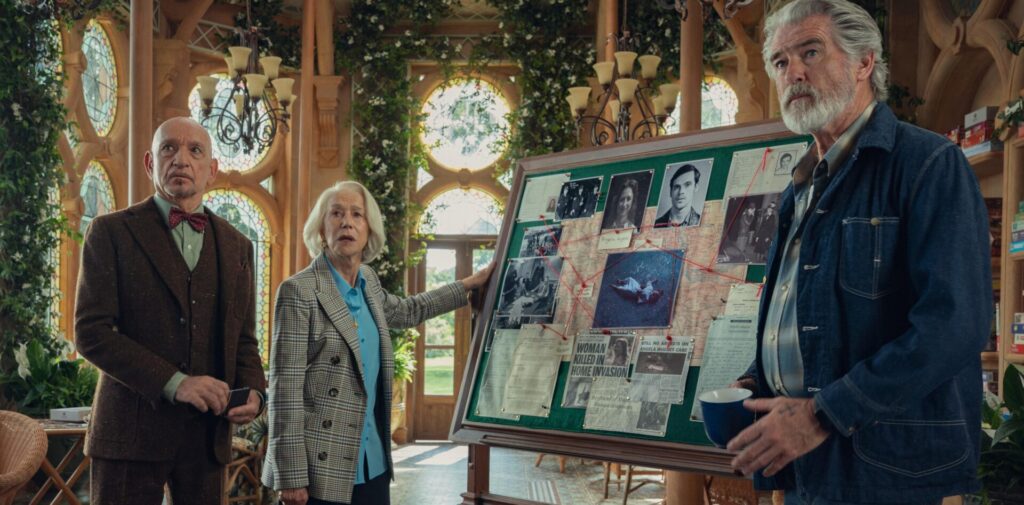
It’s not just the film’s omissions but the changes, too. There is way too much emphasis placed on the 1970s murder in the first act. The book’s best twist is what we think is a mere aside, an introductory cold case to simply introduce the characters, is actually the key to the present case in the end. The film however discusses it so often that it’s obvious that a reveal is coming. Bogdan feels like a much more two-dimensional character in the film, more malicious and even arrested at the end unlike the book. He says it was an accident but I don’t believe him. The book explicitly has him be a premediated murderer and yet he’s more likeable there than the film. Not to mention the moment where Elizabeth plays a tape of Bogdan’s confession where he states why he did it, only for her to then immediately ask “Oh Bogdan, why did you do it?” Was she not listening?
I’m also not sure about the decision to change the conflict from the book’s expansion of Cooper’s Chase to the film’s closure of Cooper’s Chase. I can see why they made this change. It heightens the stakes for the characters but it also makes the investigation more self-serving and generic. The protests might feel more like nimbyism in the book but changing it like this creates too many suspects. Literally everyone at Cooper’s Chase becomes a suspect because they don’t want to lose their home. Their ludicrously expensive home by the looks of it. The filming location makes it seem like everyone staying there would need to be millionaires.
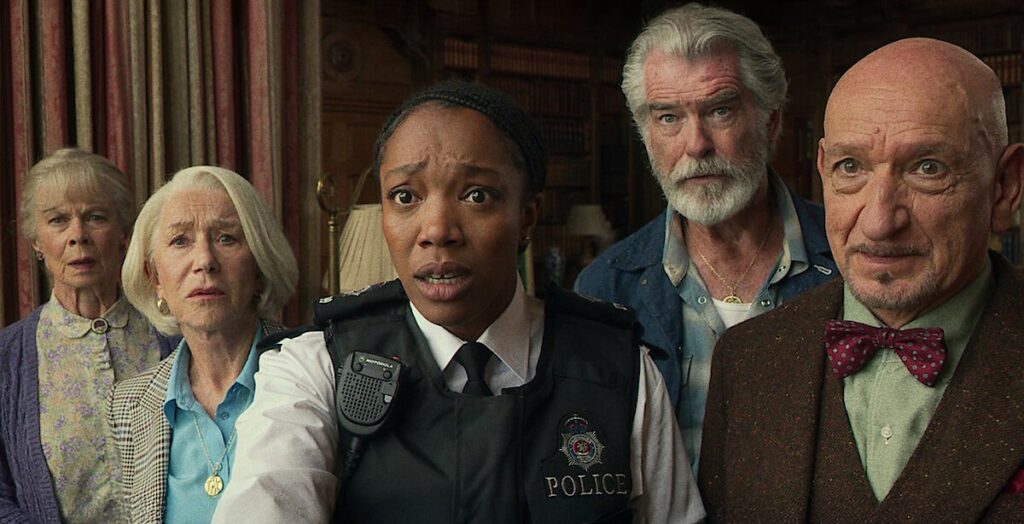
Using a big country estate for Cooper’s Chase plays into another issue I had with the film. It feels too aggressively British. Like it’s trying too hard. Director Chris Columbus is returning to the visual style of his Harry Potter films. It worked there because there’s a heightened aspect to everything, a literal magic to it. Here it felt weird, the film existing in a fairytale land of quaint police stations with blackboards and cardigan-wearing grannies with valances everywhere. An American’s view of a cartoon England. Visually overall the film is fairly flat. Even the murder scenes are dull. You see more brutality on an episode of Midsomer Murders.
But I admit there are some changes the film makes I feel are improvements. The book has a tough time with the balancing act that has come to define all entertainment that features murder: when to treat it sombrely and when it can be fun. The characters are so excited when a man is murdered because it gives them something to do. Therefore I quite like the addition of Maude, Tony’s mother being a resident of Cooper’s Chase. It allows the characters, and film itself, to remember the human life lost and that some people are actually in mourning. It was also wise to cut some of the criminal backstory. People still constantly mention “Bobby Tanner” in every conversation without giving us a reason to care about the mysterious man but it’s lessened from the book, where the gang’s past is far too convoluted, with dead taxi drivers and unnecessary trips to Cyprus.
And there are a few issues I have with the book which remain in the film. Namely, I think Elizabeth basically being a retired version of James Bond’s M kind of ruins the whole thing. The book is about not discounting the elderly. Citizens that society ignores proving their worth. That every resident of a care house has a story and a will to act, be seen and heard, and ultimately solve something the police couldn’t. Making Elizabeth a spy, a character from a different type of story, very much not a regular person or a representative of the elderly population, destroys that concept. She has crime solving cheat codes, able to request confidential documents and lab work through her old job that contradicts the idea of these regular old folks taking it upon themselves to solve a murder. Characters we can see our relatives, and ourselves, within.
Also like the book, Ibrahim has little to do in this first outing and Joyce is initially placed as the POV character, our introduction into the story, but then disappears as the film continues, with Elizabeth taking the reins. Chris and Donna also vanish towards the end, the film missing the fun subversion on a romance trope present in the novel. But for these issues, there’s always the sequels. The books keep coming and I imagine the films will too. Now that the introductions are over, the very expositional first act dialogue behind us, The Thursday Murder Club can be a wobbly first step on an otherwise solid path. The sequels just need to realise the plot is simply a delivery mechanism for what the books do so well: the characters, the themes, the ideas, the warmth, the heart and soul. All of which sadly culled or cabined in Netflix’s first attempt.