The Dog Stars: Ridley Scott’s Apocalyptic Ode to Kindness
A critical and commercial disaster, I ended up enjoying The Dog Stars because of its surprisingly sweet heart

I still have a lot of love and patience for Ridley Scott. Perhaps more patience than he does himself, with all reporting of his modern moviemaking suggesting a fast, impatient style of shooting, as if he thinks his 88 years won’t catch up with him if he just keeps churning out films. His latest effort, The Dog Stars, released to poor reviews and dismal box office returns, an apparent failure in all regards. Yet, feeling Scott has forever earned my butt in a seat and the price of a ticket, I went along to watch the film with as much of an open mind I could muster. And I liked it.
There’s a certain recalibration that must take place before watching The Dog Stars. It’s marketed as a ‘riveting thriller’, an action movie set in a post-apocalyptic world of violence. On the surface, it does appear that way. It certainly brings to mind The Last of Us and any number of similar stories, both in the visuals and with the particularly twangy guitar music. But at it’s heart, and it does have a big heart, it’s less concerned with the moral depravity of the world coming to the end and much more with the survival of kindness.
I wrote recently about The End of Oak Street, a film that appears as a light and frothy nostalgic adventure but at its core is actually quite dark and subversive in an engaging way. The Dog Stars is enjoyably the opposite: for a movie about big guys with machine guns it has an uncynical sweet streak. It’s not an action movie and there are very few thrills for it to be a thriller. It’s much more concerned with being a slow introspective drama about the survival of human decency. Most of the movie is Jacob Elordi’s character fixing broken machines, like a 100 million dollar ASMR video. It’s nice to have a big mainstream movie about fixing things, big and small.
It’s a film that is at its best when characters are being kind. Sharing food, offering coffee and cigarettes, letting them listen to music on your headphones (although if it was country like the film I’d rip them off and never speak to them again), bonding. The Dog Stars shows that the difference between a hellscape and utopia is the people. It’s a refreshingly simple, straightforward tale. Jacob Elordi’s Hig deciding there must be more to life than just surviving a brutal existence and deciding to look for others, kindness leading the way in a world in danger of forgetting it.
It is slow and methodical but I certainly never found it boring. There’s also much less traditional conflict in the story than expected. The narrative takes bold, surprising turns for the sake of happiness. Hig happens upon a father and daughter, Pops and Cima, and in any other version of this story, Pops, played by Guy Pierce, dies to leave the two younger characters together. I kept expecting it: he’ll die at his camp, or he’ll throw himself out of the plane so it can take off with less weight, or be a victim of the cannibal cult. But no, he and everyone else survives and I love that. It’s a story where people save each other, help each other, and the kindness they show prevails and means something. The biggest shock death is Hig’s dog early on, all because Josh Brolin’s character was trying to prove a point about the brutal nature of the world while kindness and honesty would have saved him.
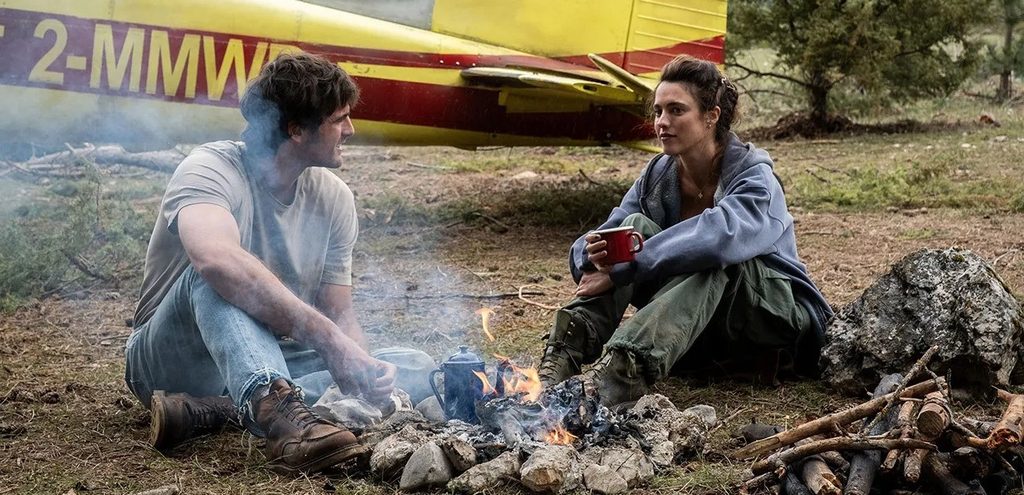
Once Hig leaves the base he shares with Josh Brolin’s Bangley, I was surprised the film continued to check in with Bangley rather than shift focus entirely. But it’s clear it was included to prove the film’s point about the cycle of violence, violence begetting more violence. He kills two people, then three more people turn up, and once those are dead thirty turn up until he is overwhelmed and his philosophy is proved ineffective. Bangley himself is given room to grow while a more generic version of this story kills him to prove him wrong. The film offers the character kindness, sparing him, allowing him to change and join the gang in forming a community.
However, there’s one element of the film I’m less sure of. The villainous tribes are portrayed almost like zombies despite being human. It’s only been about a decade since the world ended and they are unspeaking, dumb monsters. It’s pretty silly. But it works considering they are only supposed to represent the base nature of humanity, the inner beast to better and overcome. And they also allow Scott to deliver some action in an otherwise slow drama. The night vision scene is good fun, including the now obligatory Splinter Cell electronic whine sound effect when the googles are turned on. Ridley Scott may be an elder statesman of cinema but he can still put an action scene together. He’s still got it, and overall I like the look of the film, in particular the cinematography of the plane shots, although I still don’t like Scott’s desaturated blue nighttime visuals he’s been doing for a few years now.
And then there’s the sequence at Grand Junction, which might simultaneously be the best and worst part of the movie because it feels like something from another film entirely. It’s hard not to have fun with it because it is so weird. There’s always a secret cannibal group in these stories and so I appreciate Scott giving this generic part of the story some extra weirdness to keep it engaging. It almost feels like his ode to Kubrick, with the strange 70s Clockwork Orange visuals and costumes, complete with Lloyd the bartender from The Shining. And while we’ve seen it a million times before, the human body slaughterhouse stuck with me because the image of the head in a plastic bag is really unnerving. But quickly the entire airport is somehow destroyed with four hand grenades and the film flies on as if it never happened. A bizarre excursion.
At first, I felt a little disappointed that after all that Hig travels back to where he came from in the beginning, to Bangley and his old life. But the film was always more of an introspective journey than a literal one. He’s changed. Been able to process, move on, grow, accept a new kinder way of life now with a found family around him. The paradise has always been there but you can’t create utopia without first creating the utopian. The final act is a little rushed, as if the film had to be cut down to two hours and making me wonder if another extensive Ridley Scott director’s cut is out there. Hig and Cima suddenly cure some illness in the Mennonite kids and he maybe tries to kill himself but doesn’t and comes back, it’s all a little messy towards the end, but the point and purpose ultimately shines through.
I’m taking advice from the movie, embracing its lesson, and I’m choosing kindness. I’m being kind to this flawed film. I liked it. The Dog Stars is not as deep or interesting or brilliant as 28 Years Later. But it is a damn sight better than the critical and commercial reaction would suggest. It’s just a very different film than it might first appear to be, willing to tell a slow, mellow narrative apart from a couple of high octane moments. ‘Nice’ is not an adjective movies usually go for, but the characters and ideas and film overall is that. The Dog Stars is nice.